
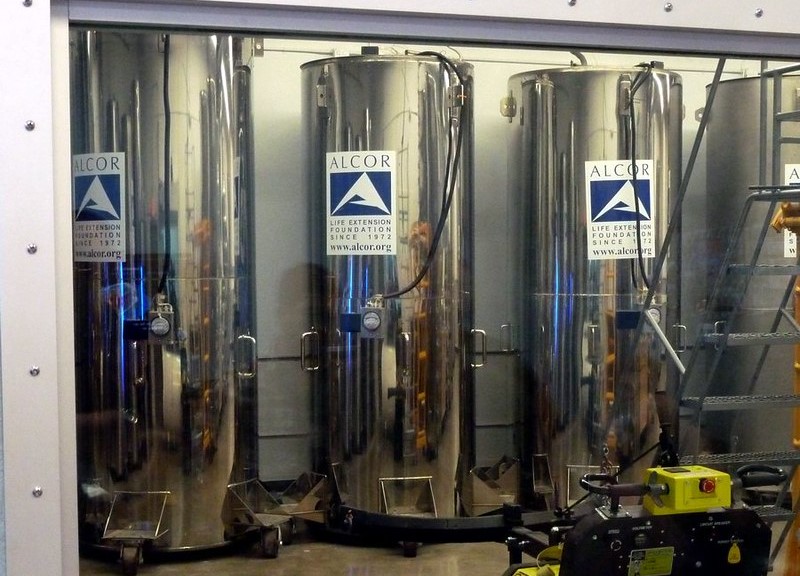
Cryonics (also called biostasis) is Plan B for all people for whom the first rejuvenation therapies are likely to come too late. In cryonics, the body (or, in the case of neuropreservation, only the brain) is gradually cooled down to -196°C after the pronouncement of death and finally stored in liquid nitrogen. At this temperature, all biological activity stops. The goal is to preserve the body until future technologies make it possible to revive this person and eliminate the cause of death. The term comes from the Greek word "kryos", which roughly translates as "frost" or "icy cold".
History and status quo of cryonics
The American college teacher Robert Ettinger is considered the pioneer of cryonics. In 1962 he published the book "The Prospect of Immortality"1, thereby launching the cryonics movement. In 1967, the first person had himself frozen - James Bedford, a psychology professor from the USA.2 Today, around 500 people worldwide are preserved in dedicated facilities, and over 4,000 have already signed a contract.3 They include some celebrities, as this list shows.4
Cryonics providers
The three largest providers worldwide are the Alcor Life Extension Foundation (Scottsdale, Arizona), the Cryonics Institute (Clinton Township, Michigan) and KrioRus (Moscow, Russia). But there are also organizations offering cryonics in Europe and even in Germany: for example, the Berlin start-up Tomorrow Biostasis. In addition to neuropreservation in Germany, the interest group Cryonics Germany also offers an opportunity for exchange and helps with legal, financial, organizational and technical questions.5
Learn more about the various cryonics providers
Vitrification
Cryopreservation is already used routinely for heart valves, larger blood vessels, human skin, sperm and fertilized egg cells (see in vitro fertilization).6 The most important step today: vitrification. In this process, the body fluids are replaced by a so-called cryoprotectant. This is necessary because freezing normally leads to the formation of ice crystals, which destroy the cell membrane and thus the tissue. When cooled, the cryoprotectant takes on a glass-like state without forming crystals.7
Death as a reversible process
But how are people who are already dead supposed to be able to live again in the future? Death is not a single event, but rather a neurological process that begins as soon as the heart stops beating.8 The goal of cryonics is to interrupt and stop this process - within a time window in which it could be reversible in the future.9 Doctors declare a patient dead when they can no longer bring the patient back to life with currently available medicine. In the past, this was the case with cardiac arrest. Today, cardiopulmonary resuscitation, developed in the 1950s, saves people all over the world every day who have suffered cardiac arrest. Science is constantly pushing the boundaries of what is considered "dead".
Cryonics aims to push these boundaries further: it ensures that the patient's condition does not deteriorate any further and gives the far more advanced technology of the future a chance to fix the patient's problem and bring them back to life. In this respect, cryonics is merely an extension of emergency medicine - a kind of ambulance to the future.10 Even after biological immortality has been achieved, it will still be useful, for example to prevent deaths from accidents or diseases not related to aging.11
A person's death is only final when the structure necessary for memory and personality (i.e. the information that makes up a person) has been destroyed to such an extent that it is theoretically impossible to restore the person. This concept is known as information-theoretic death.12
Successes in cryopreservation so far
What successes have there been so far? We have not yet managed to rewarm and revive people. However, with individual larger organs such as kidneys, the process already works. In 2009, for example, a research group led by the cryobiologist Greg Fahy succeeded for the first time in vitrifying and cryopreserving a rabbit kidney and transplanting it into another rabbit in such a way that it continued to function normally.13 A study in 2015 showed that model organisms (nematodes) can be cryopreserved and revived with their memories intact.14 Also under Fahy's leadership, researchers in 2015 vitrified and rewarmed rabbit and pig brains for the first time in such a way that the neural connections throughout the entire brain (the so-called connectome) remained almost perfectly preserved.15 You can find more about the method used for this in our post on current research in the field of cryonics!
The problem: even with vitrification, the cryopreserved body still suffers considerable damage - possibly too much damage to be revived by rewarming in the future. (Another possibility for revival is mind uploading.16 But we are still far away from that, because we still have a lot to learn about how the human brain works.) The vitrification of larger animals or humans is not yet reversible because preserving such large structures requires a great deal of cryoprotectant. This makes it impossible to restore cell function with currently available technology.
Helium persufflation: an approach with great potential
Fortunately, there is a new approach that could soon change this: helium persufflation. In this method, cold helium is pumped through the blood vessels. The big advantage is that the body can be cooled to below -120°C much faster than with the old method. In addition, this makes it possible to avoid the fractures in the tissue that still occur today. Apart from cryonics, the approach also has the potential to save countless lives: organ transplants would be possible on a much larger scale than today. Keinice Bio, the company advancing this technology, is funded by the LEV Foundation, among others.17
How is revival supposed to work?
What could revival look like in the future (apart from uploading)? The question is difficult to answer because it depends on technologies that do not yet exist in the necessary form today. However, current technological advances are promising - among others in fields such as tissue engineering, 3D bioprinting and nanotechnology. The latter would probably be necessary to truly comprehensively repair the damage at the molecular level that occurred before and during preservation. In 2022, the nanotechnologist Robert Freitas published the 700-page book "Cryostasis Revival: The Recovery of Cryonics Patients through Nanomedicine"18, in which he outlines a possible path to the reanimation and restoration of health of cryopreserved people. Here19 is his summary of the book, in which he briefly presents the concept he has worked out.
Financing, legal aspects and more about cryonics
That leaves only the question of the legal framework and financing. We will discuss this in detail in one of our upcoming posts in the cryonics series. This much in advance: for most people, a cryopreservation contract is quite affordable - through life insurance. And it is also possible to have pets cryopreserved: the Alcor Life Extension Foundation already stores almost 100 animals in liquid nitrogen.20
Sources
- https://www.amazon.com/Prospect-Immortality-Robert-C-Ettinger/dp/097434723X ↩︎
- https://www.cryonicsarchive.org/library/dear-dr-bedford-an-open-letter-to-the-first-frozen-man/ ↩︎
- https://www.tomorrow.bio/glossary/how-many-people-are-currently-cryonically-preserved ↩︎
- https://en.wikipedia.org/wiki/List_of_people_who_arranged_for_cryonics ↩︎
- Websites: https://www.alcor.org/ | https://cryonics.org/ | https://kriorus.ru/en | https://www.tomorrow.bio/ | https://cryonics-germany.org/ ↩︎
- https://de.wikipedia.org/wiki/Kryokonservierung ↩︎
- Fahy GM, Wowk B. Principles of cryopreservation by vitrification. Methods Mol Biol 2015; 1257: 21-82. doi: 10.1007/978-1-4939-2193-5_2. PMID: 25428002. ↩︎
- https://www.alcor.org/library/faq-scientists-questions/#death ↩︎
- https://www.alcor.org/what-is-cryonics/ ↩︎
- https://www.youtube.com/watch?v=JwNNdG4MZvc ↩︎
- https://www.youtube.com/watch?v=nsUWw0I_-HY&t=947s ↩︎
- https://en.longevitywiki.org/wiki/Information_theoretic_death ↩︎
- Fahy GM, Wowk B, Pagotan R, Chang A, Phan J, Thomson B, Phan L. Physical and biological aspects of renal vitrification. Organogenesis 2009 Jul; 5(3): 167-75. doi: 10.4161/org.5.3.9974. PMID: 20046680; PMCID: PMC2781097. ↩︎
- Vita-More N, Barranco D. Persistence of Long-Term Memory in Vitrified and Revived Caenorhabditis elegans. Rejuvenation Res 2015 Oct; 18(5): 458-63. doi: 10.1089/rej.2014.1636. Epub 2015 Aug 20. PMID: 25867710; PMCID: PMC4620520. ↩︎
- McIntyre RL, Fahy GM. Aldehyde-stabilized cryopreservation. Cryobiology 2015 Dec; 71(3): 448-58. doi: 10.1016/j.cryobiol.2015.09.003. Epub 2015 Sep 25. PMID: 26408851. ↩︎
- https://de.wikipedia.org/wiki/Mind_uploading ↩︎
- https://www.levf.org/projects ↩︎
- https://www.amazon.de/Cryostasis-Revival-Recovery-Cryonics-Nanomedicine/dp/099681535X ↩︎
- https://www.alcor.org/wp-content/uploads/2025/08/cryostasis-revival-summary.pdf ↩︎
- https://www.euronews.com/next/2023/01/15/inside-the-us-facility-where-199-legally-dead-humans-and-almost-100-pets-await-being-reviv ↩︎
Image source: https://www.flickr.com/photos/arenamontanus/8111396819 (modified)
Further reading:
Für immer jung mit Kleine-Gunk: Wie mit Hilfe von Kryonik der Tod ausgetrickst werden soll: https://www.youtube.com/watch?v=_C-JVeDntZ4
Wait But Why - Why Cryonics Makes Sense: https://waitbutwhy.com/2016/03/cryonics.html
Talk by Tanya Jones on cryonics at an ideacity conference - "Extending Lives Through Cold": https://www.ideacity.ca/video/tanya-jones-extending-lives-cold/
Detailed scientific article with arguments why cryonics makes sense ("Scientific Justification of Cryonics Practice"): https://www.ncbi.nlm.nih.gov/pmc/articles/PMC4733321/
FAQ by Tomorrow Biostasis: https://www.tomorrow.bio/de/faq
FAQ by Alcor: https://www.alcor.org/library/frequently-asked-questions/