
More rejuvenation research for an indefinitely long healthy life for everybody
We advocate the faster development of rejuvenation therapies that repair the damage of aging and with which people can live healthily for thousands of years. Diseases of old age and age-related death would then no longer be an inevitable fate.
Why we need rejuvenation research
Video: Logical Lemon YouTube channel: Why people will soon live twice as long (gerontology)
Expanding research in the field of rejuvenation
To this end, an additional 10% of the federal budget per year is to be invested in rejuvenation research. The European Union is to be established as one of the leading hubs for technologies for healthy life extension and for their export. With the financial resources called for, new state research facilities are to be built and operated in Germany. Furthermore, the relevant departments at universities (for example medicine, biochemistry, bioinformatics and molecular biology) are to be expanded so that they can train more people in these fields.
We have the ethical responsibility to implement the fundamental right to life enshrined in the Basic Law for all people, regardless of their age, as quickly as possible and to actively promote the opportunities for realizing a long, healthy life. We have this responsibility especially in view of the more than 100,000 age-related deaths every day and the suffering that precedes them. In addition, the faster development of the therapies is also very important economically because of the currently enormous costs of illness and care at the end of life. Rejuvenation therapies could relieve the pension and health care systems, remedy the shortage of skilled workers, strengthen our economy and pave the way for a flourishing longevity industry.
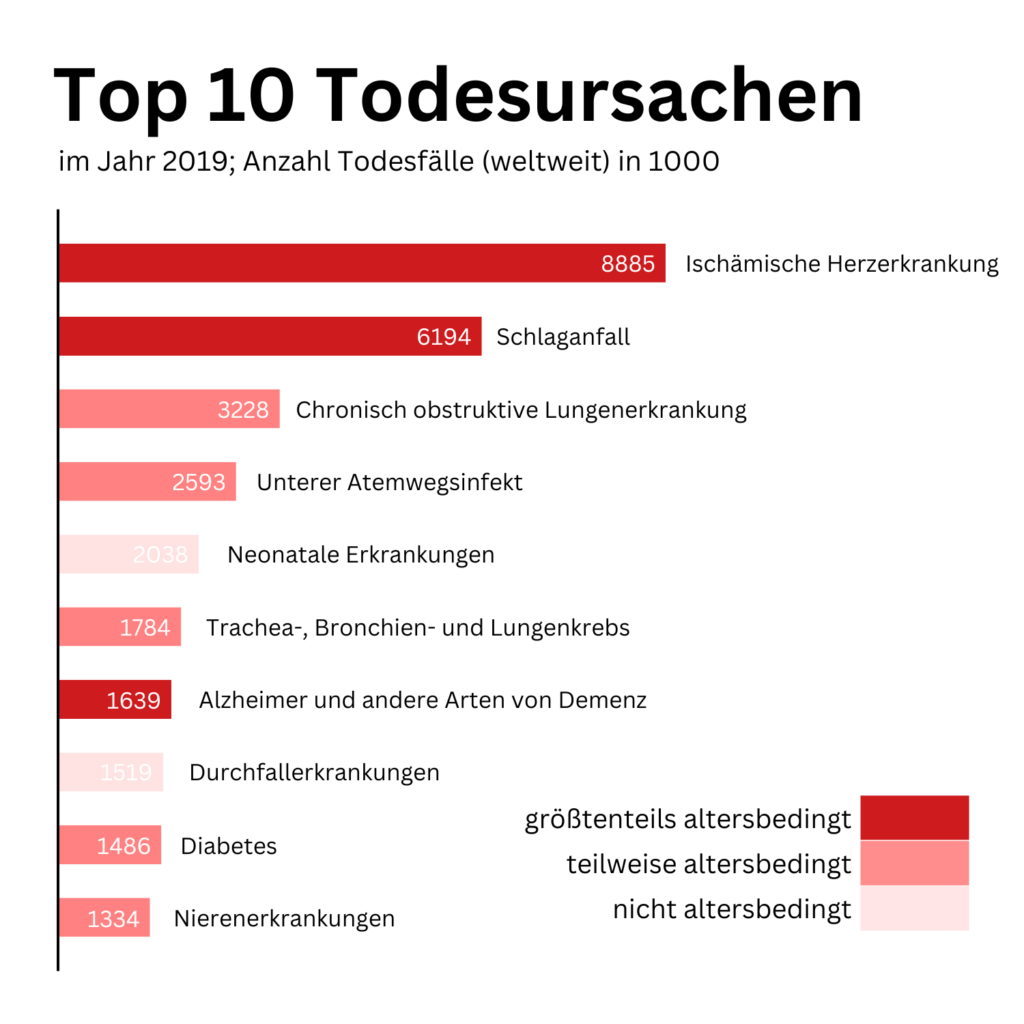
More than 100,000 people die of aging every day. Source: destatista.com
We call for a progressive and forward-looking research policy that is based on scientific progress, social responsibility and global cooperation and that makes rejuvenation research one of the top priorities. Beyond that, we want to raise awareness of the challenges of an aging society and of the aging process, and in particular draw attention to the opportunity to overcome these challenges with rejuvenation medicine.
Aging causes suffering and death
Currently, more than 100,000 people die each day from aging or from associated diseases such as cancer, Alzheimer's disease and cardiovascular disease.1 Aging thus costs more than one human life per second.
Curing aging with the repair approach and enabling indefinitely long healthy lives: with appropriate funding, a good chance of implementation within 15 years
In recent years, the so-called repair approach has become established in aging research. In the course of aging, harmful changes occur in the body as a result of normal metabolism, among other things, which, above a certain level, lead to the diseases of old age and to age-related death. Until now, the approach has been to fight diseases such as cancer or Alzheimer's one by one. Now researchers want to repair the damage at the molecular and cellular level that accumulates in the aging process. In the future, this could make it possible to biologically rejuvenate people and prevent all age-related disease.
After rejuvenation, people would continue to age because damage would continue to accumulate. This is where the concept of longevity escape velocity comes into play. According to aging researcher Dr. Aubrey de Grey, we have a 50% chance of developing, within the next 12-15 years, medicine that gives a 60-year-old 20 additional years of life.
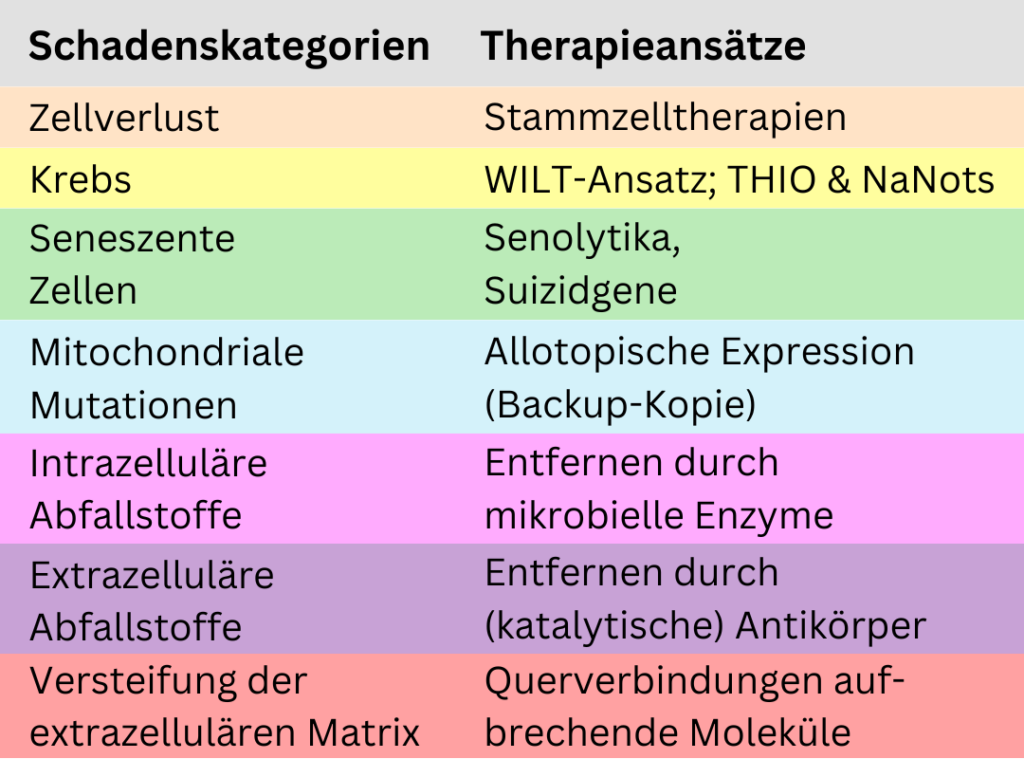
The table lists the seven damage categories according to Aubrey de Grey as well as the therapeutic approaches he proposes to repair the damage of each damage category.
Within these 20 years, however, better medicine will probably be developed that lets us live a few decades longer again, and so on. The idea, then, is to continuously improve therapies and to apply them again and again to the same people in order to repair the damage more and more thoroughly. From a certain point on, life expectancy rises on average by at least one year for every year that passes.
If we achieve this, people could live indefinitely. At the same time, they would have the appearance and the physical and mental health and fitness of a young adult. Aging would thus be curable.
The question is not so much whether we can or should develop this medicine, but rather how fast this development proceeds and when we want to reap the benefits of this medicine.
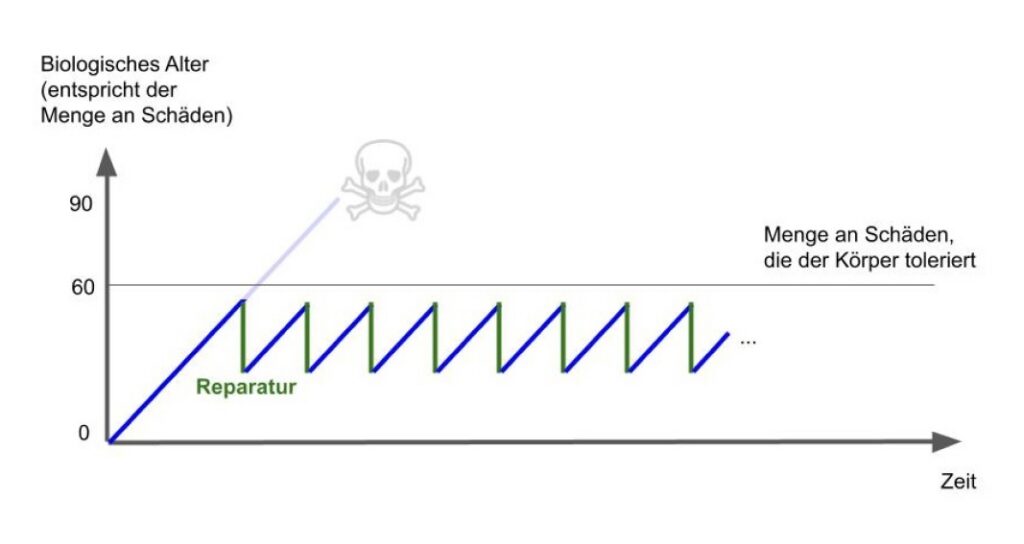
Image: The principle of the repair approach - turning back biological age at regular intervals with future rejuvenation medicine
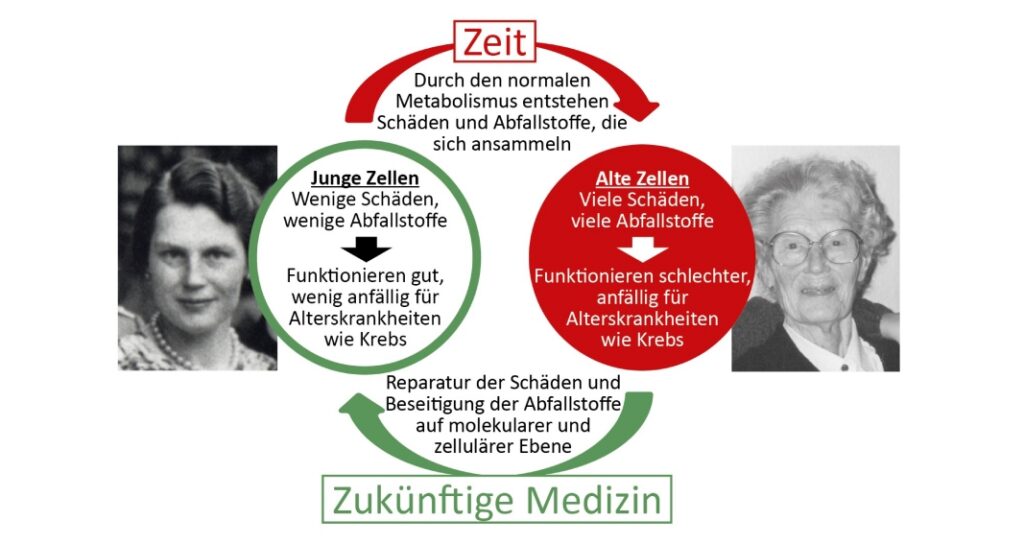
Image: Our party logo symbolizes the repair approach
The repair approach is relatively easy to implement
Reversing aging through the repair approach should be much easier to implement than, for example, slowing down aging by intervening in metabolism. This is because metabolism is very complex and not yet sufficiently understood.
To implement the repair approach, you do not necessarily need to understand metabolism, you just need to know the damage and how to repair it.
All damage can be divided into a manageable number of categories. Such categories are, for example, mitochondrial mutations, waste products inside and outside the cells, or crosslinks in the extracellular matrix. It can be assumed that all types of damage are already known. To repair the damage, approaches such as stem cell therapies, tissue engineering, senolytics, antibody therapies, enzymes from soil bacteria and cellular reprogramming are being pursued, among others.
The scientific publication "The Hallmarks of Aging", which describes the repair approach, is the most cited publication in the field of aging research of the last decade. Numerous startups, research institutes and university research groups are already working on implementing this approach, but unfortunately not nearly enough.
More and more well-known, prestigious and influential individuals and organizations are also investing large sums in aging research. For example, Google has founded the company Calico, which wants to cure aging. OpenAI CEO Sam Altman has invested in the company Retro Biosciences, which also aims to tackle aging. In addition, Facebook founder Mark Zuckerberg and his wife want to help cure, prevent or manage all diseases by the end of the century with their organization CZI.
However, implementing the repair approach is a lot of work, as there are thousands of different types of damage and therefore a great many different therapies have to be developed. That is why we are calling for the state to invest much more in implementing this approach.
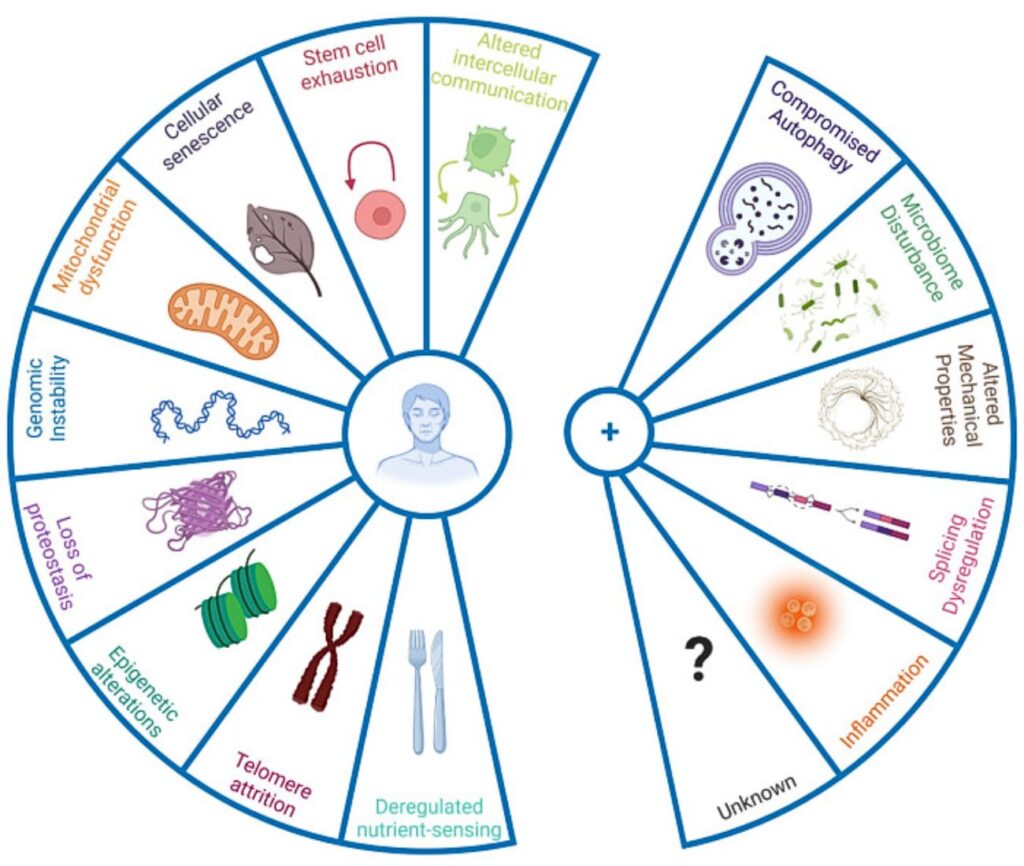
The Hallmarks of Aging; Source: Schmauck-Medina T et al. New hallmarks of ageing: a 2022 Copenhagen ageing meeting summary. Aging (Albany NY). 2022 Aug 29; 14(16): 6829-6839. doi: 10.18632/aging.204248.
Cryonics as an additional option
For people who are already too old to benefit from rejuvenation therapies, or who die of other causes, cryonics is an option. In cryonics, the body is gradually cooled after the declaration of death and then stored at -196°C in liquid nitrogen. The goal is to preserve the structure of the body (especially of the brain, in order to retain memory, personality and consciousness) long enough until future technologies make it possible to rewarm and revive the person and to cure their cause of death, for example old age.
Cryopreservation is also used today in reproductive medicine, for example to freeze fertilized egg cells. In the future, the longer-term storage of artificially produced organs could solve the global problem of organ shortage. The cryopreservation of placental tissue after birth offers the possibility of isolating stem cells when needed and using them for treatments of the child, the family or other patients.
That is why greater funding of research in the field of cryopreservation would also make sense.
Worries and objections regarding rejuvenation therapies bear no relation to the suffering caused by aging today
New problems may arise from curing aging. However, every invention and exploration of new approaches carries opportunities as well as risks. We believe that societal risks should not prevent us from speeding up the development of rejuvenation medicine that can solve the humanitarian problem of aging. Instead, we should be open to the challenge of solving future societal problems that might accompany rejuvenation medicine and engage in more discussion about them.
After all, there are already good solutions to almost all the problems that are mentioned in connection with a strong prolongation of life. Many fear, for example, that overpopulation will result. However, calculations show that in a scenario without age-related death the population grows much more slowly than one would intuitively assume. Since rejuvenation therapies will also postpone menopause, women would also have the chance to have children much later, for example in order to devote themselves to their careers first. This will probably slow down population growth even further.
The problem with overpopulation is not that there is too little space, but environmental pollution and how we use resources. New technologies in food production, power generation and other areas are expected to significantly increase the carrying capacity of the Earth in the foreseeable future. These include, among others, renewable energy, desalination plants, lab-grown meat, vertical farming, algae farms, 3D printing, nuclear fusion and synthetic fuels.
Moreover, the societal challenges that come with rejuvenation therapies only arise gradually. We would probably have several centuries to find solutions. It would be immoral to decide today, on the basis of speculation about problems of a distant future, not to develop life-saving medicine as quickly as possible.
Another point is that the problems that might arise from rejuvenation therapies are disproportionate to the current problem of more than 100,000 deaths per day from aging. They are nowhere near that big and could very likely be solved, so they cannot be an argument for not accelerating the development of effective anti-aging medicine. Conversely, in an ageless world, we would not solve these problems by inventing and introducing aging and all its associated diseases either.
Benefits of rejuvenation research at the individual level
By promoting the development of rejuvenation therapies, people would probably have the opportunity and free choice to use them sooner. People who decide to use rejuvenation therapies could benefit from the combination of youthful vigor and life experience, educate themselves in many different fields, bring new ideas into society, spend more time with family and friends and also get to know their great-great-great-grandchildren.
Strengthening the health care system and lower health care spending
Currently, the costs of illness in old age account for a considerable share of total expenditure in the health care system, since age-related diseases and health problems require comprehensive medical care.2 With the availability of rejuvenation therapies, health care spending will be greatly reduced, since lower care costs arise and fewer expensive treatments for individual diseases of old age are needed.
Some renowned economists estimate that even a slowing of aging that increases life expectancy by just one year has an economic value of several trillion dollars for the USA over a period of a few decades.3, 4
Intensified research on therapies against aging will also benefit other medical fields. On the one hand, it will allow us to learn new things faster about the mechanisms that take place in our body. On the other hand, in the course of developing rejuvenation medicine we will improve methods and technologies for diagnosing and treating other health problems as well. One example is the CRISPR/Cas system known as gene scissors, with which all hereditary diseases can probably be cured in the future.
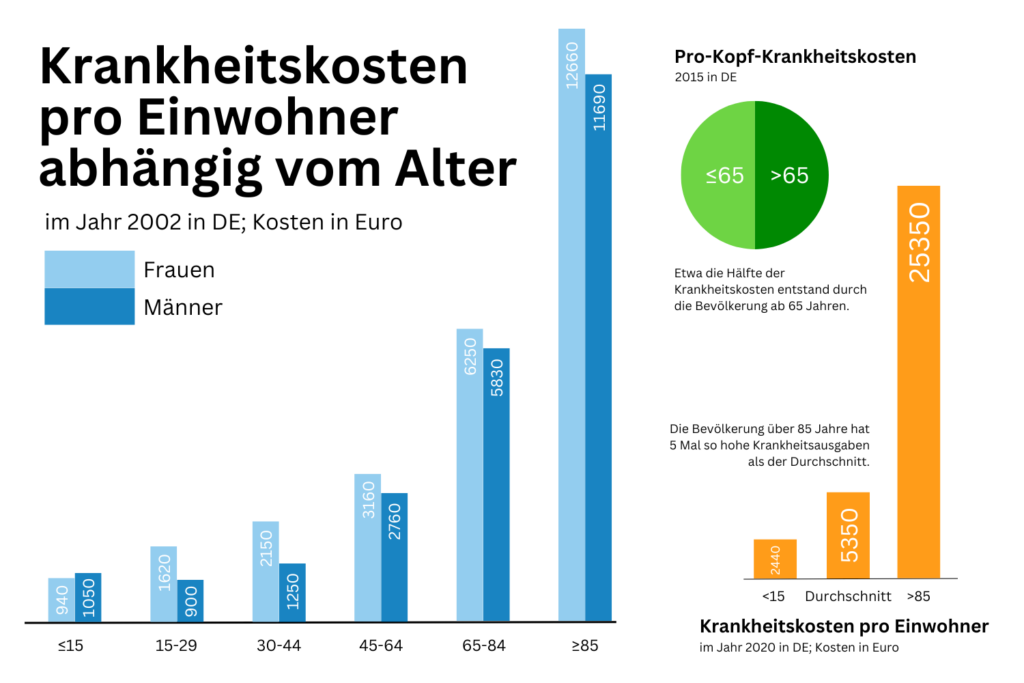
Direct costs of illness rise immensely with age: About half of the costs of illness are caused by the population aged 65 and over, and the population over the age of 85 has health expenditures five times as high as the average.
Sources: Destatis | GBE-Bund.de | Destatis
The savings in the health care system make it possible to use these resources for other purposes, for example to improve quality of life, for personal development or for societal purposes.
Furthermore, the savings in health care spending could help to reduce the burden on public health care systems and thereby improve access to health care for everyone. Through a more efficient use of health care resources, more people could benefit from high-quality medical care.
Further economic and social benefits of rejuvenation therapies
In pension policy and with regard to the problem of demographic change, rejuvenation therapies could offer a revolutionary solution. By living longer and healthier lives, people would have the opportunity to work longer and could contribute to relieving the financial burden on social security systems. This would ease the pressure on young generations and stabilize the economy.
Furthermore, extending the working capacity of older people could help to counteract the shortage of skilled workers. By retaining and using the knowledge and experience of older employees, companies could benefit from a broader and more diverse workforce, which would increase productivity.
The introduction of rejuvenation therapies could fundamentally change the world of work and every individual's options for shaping their life. Currently, a common life course is to spend the first 25% of life in education, then 50% working and finally 25% being ill. The availability of rejuvenation therapies would break this pattern.
A longer lifespan would allow people to take several years of vacation in between, return to phases of education or embark on new career paths. In addition, artificial intelligence and automation will probably eliminate many unpleasant tasks.
More government investment in rejuvenation research
We call for investing an additional 10% of the federal budget per year in rejuvenation research. Half of the investment is to go into the construction and operation of state research facilities. In these facilities, research groups are to work on therapies against the various kinds of damage of aging.
With the other half, the relevant departments such as medicine, biochemistry, bioinformatics and molecular biology are to be expanded at universities and more people are to be trained in these fields.
Strengthening global cooperation in biomedical research through better regulation of health data
For the handling of medical data, significantly better regulations are still needed. One example is the acceleration of research based on health data through less bureaucracy, faster approvals, simpler consent forms and so on. Also helpful would be a standardization of medical records and biobanks as in the United Kingdom, as well as of the way in which citizens in Finland share their data. In the Finnish system (opt-out), all stored data can be accessed in anonymized or pseudonymized form for approved research projects, provided the patient has not filed an objection. In other countries, it is exactly the other way around: in order to access data, the patient must have given explicit consent.
In our view, it should be easier especially for older people to take part in clinical trials. One possibility would be a requirement (with some exceptions) that at least 25% of study participants be older than 65. We could prohibit a maximum age for volunteers in clinical trials.
In our opinion, all future clinical trials should be required to store their data in databases and to make it available for research. Furthermore, we consider it crucial to make the research results that are made possible by citizens' data accessible to all citizens as well.
Strengthening Germany as a location for research and business
Germany has the chance to become a global pioneer in rejuvenation research. Since all people worldwide age and need these therapies, we could export knowledge and medicine in the future.
The creation of an attractive research environment through targeted investment in research infrastructure, as well as the promotion of interdisciplinary cooperation in the field of rejuvenation research, can strengthen Germany as a business location and pave the way for a flourishing longevity industry.
Vote for us
We are on the threshold of the greatest revolution in human history: liberation from age-related death. Our generation could be the first that no longer looks on helplessly as its loved ones suffer from dementia, cancer or heart disease. What industrialization was for the economy, rejuvenation research will be for our quality of life.
We have the chance to create a world in which our lives are no longer limited by aging. The future is in our hands - let us shape it together!
Sources:
- GBD 2017 Causes of Death Collaborators. Global, regional, and national age-sex-specific mortality for 282 causes of death in 195 countries and territories, 1980-2017: a systematic analysis for the Global Burden of Disease Study 2017. Lancet. 2018 Nov 10, 392: 1736-88. doi: 10.1016/S0140-6736(18)32203-7. (https://www.thelancet.com/journals/lancet/article/PIIS0140-6736(18)32203-7/fulltext)
- Diernberger K, Luta X, Bowden J, Fallon M, Droney J, Lemmon E, Gray E, Marti J, Hall P. Healthcare use and costs in the last year of life: a national population data linkage study. BMJ Support Palliat Care. 2021 Feb 12: bmjspcare-2020-002708. doi: 10.1136/bmjspcare-2020-002708. (https://spcare.bmj.com/content/early/2021/02/11/bmjspcare-2020-002708)
- Scott AJ, Ellison M, Sinclair DA. The economic value of targeting aging. Nat Aging. 2021 Jul; (7): 616-623. doi: 10.1038/s43587-021-00080-0. (https://www.nature.com/articles/s43587-021-00080-0)
- Goldman DP, Cutler D, Rowe JW, Michaud PC, Sullivan J, Peneva D, Olshansky SJ. Substantial health and economic returns from delayed aging may warrant a new focus for medical research. Health Aff (Millwood). 2013 Oct; 32(10): 1698-705. doi: 10.1377/hlthaff.2013.0052. (https://www.healthaffairs.org/doi/10.1377/hlthaff.2013.0052)