
In old age, almost all people suffer from age-related diseases such as cancer, Alzheimer's, stroke, heart attack, type 2 diabetes, macular degeneration, osteoarthritis, osteoporosis and Parkinson's.
With today's technologies in the life sciences and new approaches from conventional medicine, we have a good chance of developing effective medicine against these diseases of old age, so that old people remain physically and mentally healthy.
The Party for Rejuvenation Research wants to accelerate the development of such medicine. It deals only with this one issue and, if it takes part in a government, leaves other political issues to its coalition partners.
Statistics show the extent of the problem: more than a third of all women and about half of all men develop cancer in the course of their lives 1.
The proportion of adults with known type 2 diabetes is estimated at seven to eight percent 2, and cardiovascular diseases 3, which occur mainly in old age, are among the most common human diseases. 24 percent of 70- to 85-year-olds have five or more diseases at the same time 4. In Germany there are currently almost 1.6 million people with dementia. Of those over 90, about 41 percent suffer from dementia 5.
The fundamental causes of diseases of old age are already known: during aging, a multitude of molecular and cellular damage arises, which gradually accumulates and over time leads to a higher susceptibility to diseases of old age 4.
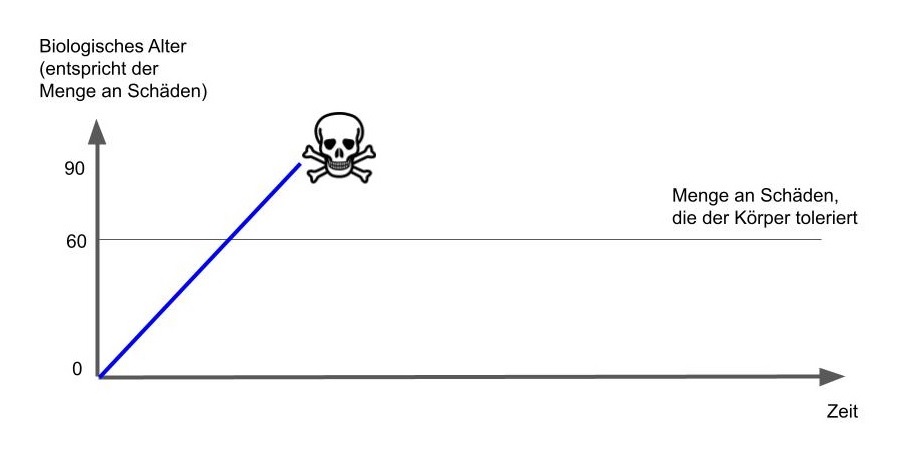
Fig. 1: Simplified representation of aging or of the aging process (more precisely, the amount of damage rises more steeply in old age, and the amount of damage the body tolerates is not reached at an exact age, but at an approximate age or within an age range).
Possible approaches to effective medicine against diseases of old age target this damage, that is, the actual cause of diseases of old age. The accumulation of damage can either be slowed down, or damage that has already formed can be repaired (the so-called repair approach).
One of the advantages of the repair approach is that it also helps older people in whom a lot of damage has already accumulated. With it, the body is practically rejuvenated. Such rejuvenation medicine (rejuvenation biotechnology) could be applied again and again at intervals, thus keeping the amount of damage within a range in which diseases of old age practically do not occur. If the repair is done well enough, people could theoretically live healthily for an unlimited time, or until they die of something else, such as an accident. Aging would be completely under medical control.
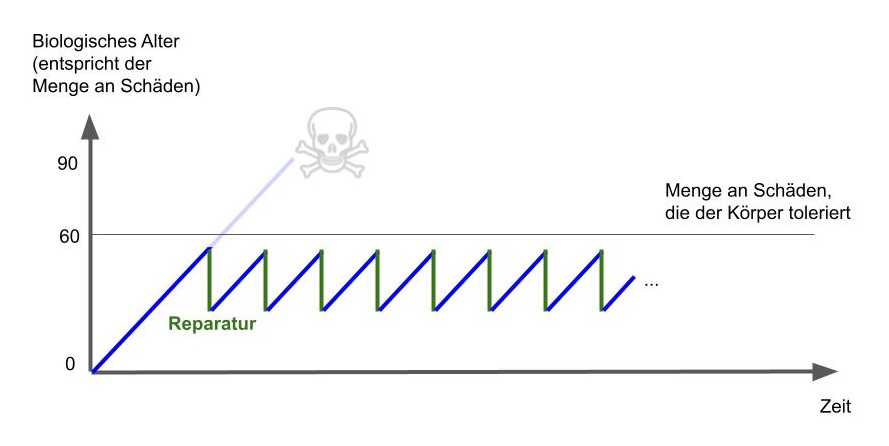
Fig. 2: Illustration of the principle of the optimally implemented repair approach
One part of the repair approach is, for example, the removal of aged cells that have lost their original function. In mice, this led to a considerable improvement in the health of old animals 6. Several of the world's leading research groups are currently working on medicine for humans that removes the aged cells.
At the following link you can see the impressive result of a research group at the Mayo Clinic College of Medicine in Rochester, Minnesota: the two mice in the photo are the same age, but the mouse on the right already looks more vital and healthier from its appearance alone, thanks to its smooth fur and taut skin (on the ears). The mouse on the left is untreated; the one on the right underwent a systemic therapy against senescent cells.
Photo: This is how the removal of aged cells affects mice
During aging, a great many different kinds of damage or harmful changes arise that need to be repaired. Scientists have divided these into various categories and describe possible interventions for these categories. The two most popular classifications are The Hallmarks of Aging and SENS. All damage known so far can be assigned to one of these categories, and for each category there is already an approach for an intervention (at least with SENS). According to our current state of knowledge, we can therefore develop medicine for all damage.
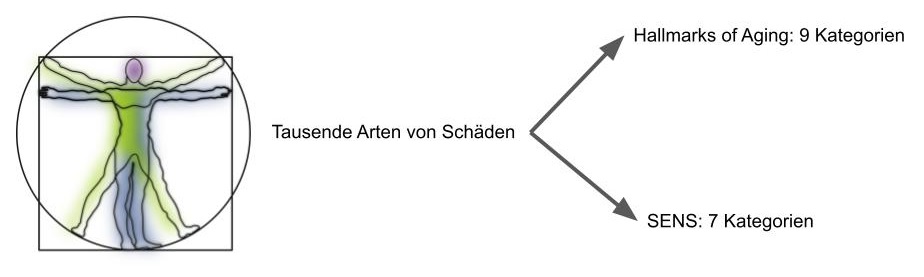
Fig. 3: Classification of aging damage into categories
The Rejuvenation Roadmap of the Lifespan Extension Advocacy Foundation lists numerous therapies against individual types of damage that are currently in development, sorted by the nine categories of the Hallmarks of Aging. And at https://www.agingbiotech.info/companies/ there is an extensive list of companies, many of which are working on individual components of the repair approach. However, since a great many different kinds of damage arise in the human body during aging, a great many different therapies must also be developed for the repair approach.
The global scientific community is slowly beginning to develop effective agents and therapies that are to be used causally (instead of symptomatically) against diseases of old age. For this purpose, more and more tools such as CRISPR, stem cell technologies and bioinformatics are also available to it today.
So the more we invest in the development of new effective medicine, the faster progress can be made and the sooner the immense suffering caused by diseases of old age can be avoided.
That is why the Party for Rejuvenation Research wants to invest considerably more state funds in the development of effective medicine against diseases of old age. Since all people are directly or indirectly affected by diseases of old age, everyone would benefit from this.
Half of these additional investments are to go into the construction and operation of new research facilities; with the other half, more scientists are to be trained in the relevant fields. To this end, the corresponding departments at universities are to be expanded.
But the faster development of effective medicine against diseases of old age is not only a question of solidarity and ethics. Germany would also benefit greatly from it economically in many respects. The costs of illness and care are already enormous today and keep rising with demographic change. A drastic reduction in diseases of old age will greatly lower these costs and thus mean an enormous economic gain. In addition, this medicine against diseases of old age will establish itself worldwide as one of the largest branches of industry in the future, since every person needs it in old age. Through more investment in this area, Germany will further expand its role as one of the most important locations for science in Europe.
Young people will also benefit from our plan: in addition to the financial relief from falling costs of illness and care, they will, for example, no longer have to watch their parents suffer from dementia. More training positions and jobs will be offered in this field in the future. Moreover, the young generation will also be old one day and will then depend on this medicine.
We now have the chance to drastically reduce the immeasurable suffering caused by age-related diseases. But if we want this chance to be seized, we must act now. Together we can do it. We depend on your help and invite you to be part of it. Join in! You can, for example, exchange views on the topic on the Gesundheitsspanne Discord server and/or become a member of our party.
Let us make a start in Germany and take on a pioneering role. Hopefully, many other nations will soon invest more heavily in the development of the urgently needed effective medicine against diseases of old age.
Video: Logical Lemon YouTube channel: Why people will soon live twice as long (gerontology)
Video: TED YouTube channel: Aubrey de Grey says we can avoid aging
Video: frustfreilernentv YouTube channel: Why do we age?
"Rejuvenation" explained in more detail
If terms like "anti-aging" and "rejuvenation" immediately make you think of cosmetics and skin care: our topic has nothing to do with that. In contrast to other anti-aging measures, "rejuvenation" here refers to targeted intervention in the human body in order not merely to slow down, but to reverse the biological aging process, which affects not only the skin but all parts of the body and all organs. A promising and well-known approach for this is called "Strategies for Engineered Negligible Senescence" 8, SENS for short, on whose implementation a constantly growing industry is now working.
The SENS repair approach is based on the fact that the human body is nothing other than a complicated machine with moving parts. Machines - defined here as structures that perform certain functions - accumulate damage over time as a result of their normal operation (that is, unfavorable changes in their structure). This is rooted in the laws of physics and can also be observed in everyday life: the longer a car is used, the more breaks down. Since in machines function results from structure, damage, if it is large enough, leads to problems in function, and the accumulation of damage leads to a continuous deterioration of function. Human cells and organs also suffer damage due to constant operation (called metabolism in living beings), which in turn affects the functions of the organism. Unlike a car, our body does have many self-repair mechanisms that prevent it from falling apart after only a short time. But because these mechanisms are not perfect, more and more damage accumulates over time and at some point exceeds the level up to which we can tolerate it: the body has difficulty maintaining its functions (see diseases of old age such as heart attack, Parkinson's and Alzheimer's) and finally gives up the ghost.
Aging is therefore more a mechanical than a biological phenomenon, but how can we now define it briefly and concisely? It is often claimed that aging is very difficult to define. That is true if you are looking for a definition that is suitable for all purposes, but when it comes to interventions in the aging process, an overall uncontroversial definition is easy to find. A typical one reads as follows:
Aging is a series of side effects of metabolism that change the structure of our body over time in unfavorable ways, so that it eventually becomes less functional.
The goal of SENS is therefore to regularly repair the molecular and cellular damage of the body (that is, the "side effects of metabolism" mentioned above) and thereby keep it below the threshold mentioned above 9. The fact that maintenance and repair work for machines can be seen from cars that are already over 100 years old and were originally designed to be roadworthy for only about 15 years, but nevertheless still function as well as at the time they were completed 10. They still function because people have maintained them with sufficient care. Of course, in humans we have to fix different damage: while with cars we treat the body shell with rust inhibitors, remove deposits with gasoline additives and replace aged parts with new ones, in the case of our body we have to work, for example, with stem cells and the enzymatic removal of waste products. But the principle is the same in both cases: through repair, the structure, and thus the function, can be preserved.
So the researchers pursuing this approach do not want to cure aging like an infection with a single treatment. That would require a deep understanding of human metabolism, which today we are far from having - on the contrary, we are only scratching the surface in this respect, if at all, because our metabolism is an immensely complex system with countless interactions 9. The aim is rather to control aging by regularly reversing it 11. This makes use of the fact that you do not need to know how damage arose in order to be able to repair it. A car mechanic who replaces a windshield does not need to know the size and composition of the stone that damaged the glass. Likewise, we do not need to know the details of free radical chemistry to render mitochondrial mutations harmless. For those treated, on the other hand, none of this makes any difference, apart from the fact that the treatment has to take place regularly.
Longevity Escape Velocity
The "first-generation" therapies for humans will not be perfect. They will repair some aging damage very well, other damage less well or not at all. If we simply apply the same therapies again and again - no matter how often or how thoroughly - the unrepaired damage will continue to accumulate. In the end, we will only experience age-related decline and death at an older age.
To keep aging at bay permanently, it is therefore not enough to repeat the therapies at regular intervals. We have to improve them in the meantime and apply the improved version each next time. This is where the concept of "longevity escape velocity" (LEV for short) comes into play 12. What does it mean? The term refers to the speed at which we need to improve the thoroughness of repair over time in order to prevent the overall level of damage in the body from continuing to rise - in other words: in order to keep our biological age, defined as the amount of damage in our body, constant or to reduce it. If we reach this speed, we would increase the remaining life expectancy of the people receiving the treatment faster than time passes in the meantime (for example by more than one year per year) 13. A 52-year-old who has a life expectancy of 80 years (that is, 28 remaining years) would accordingly gain more than one year of life during his 53rd year of life - his life expectancy would rise to over 81 years, and the following year to more than 82. The expected (age-related) end of people's lives would thus move away from them faster than they approach it.
It is to be expected that, once we have reached LEV, we will (excluding global catastrophes and similar scenarios) never again fall below this speed, since with increasing thoroughness of the therapies the amount of damage that needs to be repaired keeps decreasing (after all, the complexity of aging is not infinite but finite). As a result, the remaining damage needs more and more time to reach a critical level, and the speed required for improving the therapies decreases as well.
- Krankenkassen Deutschland: "Jeder zweite Mann und jede dritte Frau erkranken an Krebs"
- Diabetes heute: "Entwicklung des Diabetes in Deutschland dramatischer als bisher erwartet"
- Federal Ministry of Education and Research: "Herz-Kreislauf-Erkrankungen gehören zu den häufigsten Erkrankungen des Menschen."
- World Health Organization: Zusammenfassung - Weltbericht über Altern und Gesundheit
- Deutsche Alzheimer Gesellschaft e.V.: Die Häufigkeit von Demenzerkrankungen
- Baker, D. J., Childs, B. G., Durik, M., Wijers, M. E., Sieben, C. J., Zhong, J., … Van Deursen, J. M. (2016). Naturally occurring p16 Ink4a -positive cells shorten healthy lifespan. Nature, 530(7589), 1-5. http://www.nature.com/nature/journal/v530/n7589/full/nature16932.html
- Zealley B, de Grey ADNJ. Strategies for engineered negligible senescence. Gerontology 2013, 59(2): 183-9. doi: 10.1159/000342197. Epub 2012 Oct 1. PMID: 23037635.
- de Grey ADNJ. A strategy for postponing aging indefinitely. Stud Health Technol Inform 2005, 118: 209-19. PMID: 16301780.
- See, for example, the car "Benz Victoria Nr. 99", built in 1894, which is registered as a road vehicle in Germany: https://www.spiegel.de/auto/fahrkultur/benz-victoria-von-1894-das-wohl-aelteste-originale-auto-der-welt-a-1282265.html
- See also the introductory TED talk "A roadmap to end aging" from 2005. The "engineering approach", that is, repairing the damage, is explained in even more detail in the book "Niemals alt! So lässt sich das Altern umkehren. Fortschritte der Verjüngungsforschung" (ISBN 978-3-8376-1336-0) by the biogerontologist Aubrey de Grey and his research assistant Michael Rae.
- https://de.wikipedia.org/wiki/Longevity_escape_velocity
- de Grey ADNJ. Escape Velocity: Why the Prospect of Extreme Human Life Extension Matters Now. PLoS Biol 2004; 2(6): e187. doi: 10.1371/journal.pbio.0020187