
Cryoprotectants are liquids that protect biological material from freezing damage - for example, from crystallization. They work similarly to antifreeze, which we put in our cars in sub-zero temperatures to lower the freezing point of water.
Some Arctic and Antarctic animals (e.g. insects, fish or frogs) produce cryoprotectants (antifreezes such as glycerol or so-called antifreeze proteins) in their bodies to avoid freezing damage from the cold winter temperatures.
Why does vitrification require cryoprotectants?
The freezing of water in the body causes two types of damage: mechanical and chemical. We have already addressed the mechanical damage in our previous posts: it occurs because sharp ice crystals form and cut through cell membranes or other tissue.
In addition, however, chemical damage also occurs. Normally, the water in a living organism is part of a solution consisting of many different types of molecules. When the water molecules freeze, they seek each other out and form pure frozen water that pushes all other molecules out of the ice. This leads to a high concentration of harmful solutes in the remaining liquid water. For this reason, vitrification (replacing the blood with a cryoprotectant that forms a glass-like state when cooled) has been standard in the cryopreservation of organs and in cryonics for more than 20 years.
History of cryoprotectants
Until the turn of the millennium, cryonicists used glycerol as a cryoprotectant. However, glycerol is quite toxic to our cells and not suitable for vitrifying organs or even a whole body. In 2001, the Alcor Life Extension Foundation therefore switched to B2C, a particularly concentrated form of the cryoprotectant VM3. At that time, VM3 was already commonly used in the vitrification of oocytes and renal cortex of mice. In addition, VM3 showed the lowest toxicity in the vitrification of the hippocampus (part of the brain) of rats. In 2005, there was another switch to the cryoprotectant M22, which the organization still uses today - more on this below.
Cryoprotectants: composition and mode of action
Every modern cryoprotectant consists of a mixture of penetrating and non-penetrating chemicals. Penetrating chemicals enter the interior of the cell and prevent ice formation there. Non-penetrating chemicals prevent the formation of ice between the cells. They do this by forming hydrogen bonds with the water molecules, thus preventing them from organizing into an ice lattice.
Penetrating and non-penetrating chemicals
The penetrating chemicals are regularly used together with the non-penetrating chemicals, because ice tends to form extracellularly rather than intracellularly (the water flows out of the cells and then crystallizes in the spaces between them). If non-penetrating components are present, the penetrating components do not need to be as concentrated. This is crucial for high-quality cryopreservation, because the higher the concentration of penetrating chemicals, the more toxic the cryoprotectant. The right mixture of penetrating and non-penetrating solutions can provide a high level of protection with low toxicity without compromising the quality of vitrification. We also now know that toxicity can be reduced further by adding so-called synthetic ice blockers to the mixture. Synthetic ice blockers (SIBs) are compounds that inhibit the growth of ice crystals. If they are part of the cryoprotectant, fewer toxic components are needed to still ensure good vitrification.
Method for measuring the toxicity of cryoprotectants
Cryobiologists have also found that the overall toxicity of a cryoprotectant can be predicted using a measure called qv*. 21st Century Medicine developed this measurement method based on tests with K+ and Na+ ions (positively charged potassium and sodium atoms) on rabbit kidneys. The Na+ concentration outside a cell is usually 10 times higher than inside a cell, while the K+ concentration inside a cell is usually 20 to 35 times higher than outside. The membrane enzyme Na/K-ATPase, using one molecule of ATP, transports three Na+ ions out of the cell in exchange for two K+ ions that are brought into the cell. If the cell membrane is ruptured or if a cell is no longer able to produce ATP, the K+/Na+ ratio changes.
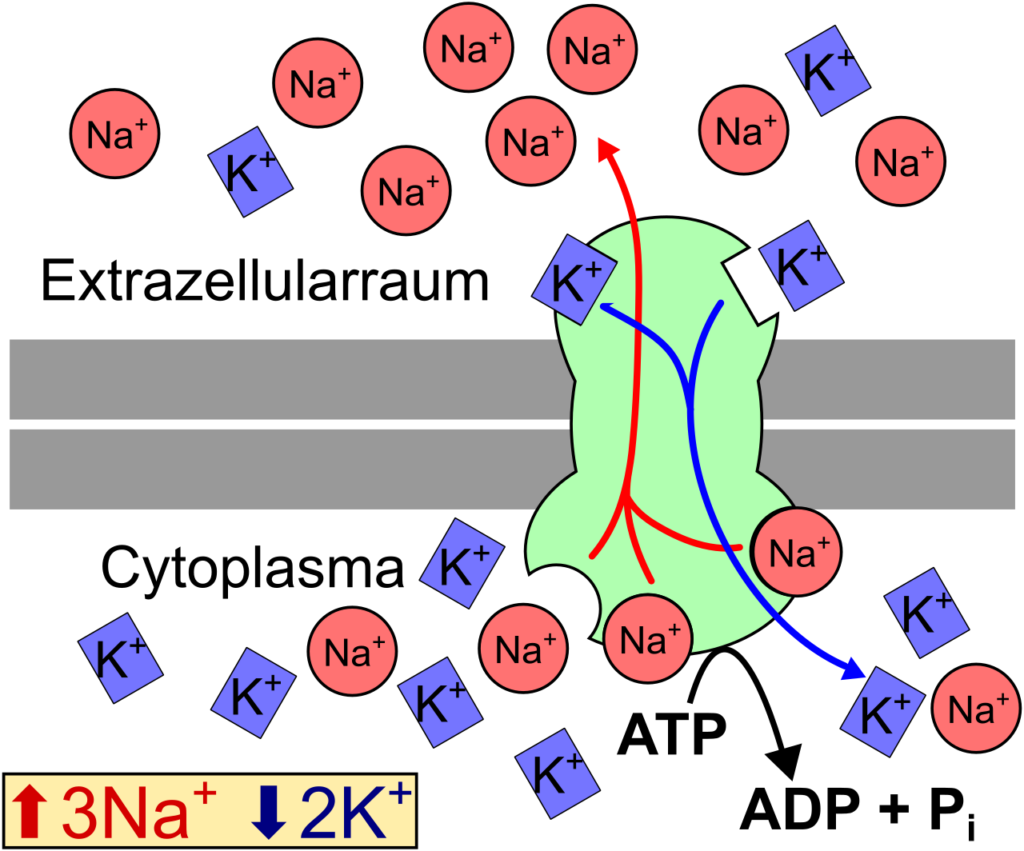
Sodium-potassium pump. Image from Wikimedia Commons: https://commons.wikimedia.org/wiki/File:Natrium-Kalium-Pumpe.svg License: CC BY-SA 4.0
qv* measures the average strength of the hydrogen bonds between the polar groups of the cryoprotectant and the water molecules of a solution. Quantitatively, qv* represents the number of water molecules per unit volume divided by the number of moles of polar groups of the cryoprotectant at the minimum concentration required for vitrification under standardized conditions. This measure thus enables the targeted production of solutions with the lowest possible toxicity.
Cryoprotectants currently in use
The two cryoprotectants mainly used in cryonics today are M22 (patented by the company 21st Century Medicine) and VM1. While VM1 is designed only for the cooling process, the designers of M22 also made sure to make the solution as non-toxic as possible (to minimize damage during rewarming). M22 is also better researched than VM1, but also considerably more expensive: its use costs a five-figure amount, while VM1 comes to only a few hundred euros.
The Cryonics Institute and Tomorrow Biostasis both use a version of VM1 that they have modified themselves. Tomorrow Biostasis gives as its reason that, thanks to the lower price of VM1, the company saves money and can instead invest in logistics, infrastructure and training of the standby teams in order to be able to respond more quickly.
The Alcor Life Extension Foundation uses M22 to ensure the best possible quality of cryopreservation and the best protection of brain structures currently possible.
Interestingly, both M22 and VM1 consist of the same core components: ethylene glycol and dimethyl sulfoxide (DMSO). M22 additionally contains formamide, which has only low toxicity in the presence of DMSO.
M22
The least toxic cryoprotectant, M22, has been licensed by the patent holder 21st Century Medicine to the Alcor Life Extension Foundation since 2005 and is used by many laboratories worldwide for the cryopreservation of tissue samples. It gets its name from the fact that it is meant to be introduced into the patient at -22°C. M22 is based on the finding that dimethyl sulfoxide (DMSO) can neutralize the toxicity of formamide. That is why M22 contains exactly equal amounts of the two substances.
M22 contains two ice blockers - synthetically produced polymers that inhibit the nucleation of ice. The first consists of polyvinyl alcohol (PVA) and vinyl acetate and is sold by 21st Century Medicine under the name X-1000. The other, named Z-1000, is polyglycerol. It specifically inhibits the nucleation caused by the bacterium Pseudomonas syringae. Mixtures of the two ice blockers are more effective at inhibiting ice formation than either agent alone, which suggests that they complement each other by inhibiting different sources (bacterial and non-bacterial) of ice formation. In order to support cell metabolism at low temperatures and to prevent oxidative damage and edema (accumulation of fluid in tissue), M22 also requires a suitable carrier solution.
M22 causes considerable shrinkage of the brain during the perfusion of patients. In fact, cerebral dehydration can be an important factor in the vitrification of the brain and can even make it possible to preserve the brain with lower concentrations of M22.
The most significant advances in cryopreservation, such as the successful vitrification, rewarming and transplantation of a rabbit kidney in 2009, have been achieved with M22. However, unlike VM1 or older cryoprotectants, M22 consists of eight different components, and together with the carrier solution there are 15. Components such as the ice blockers have caused the cost of cryopreservation at Alcor to exceed that of preservation at the Cryonics Institute many times over. This naturally raises questions about costs and benefits.
The idea behind using M22 is that better vitrification will lead to a lower need for future repair technologies and consequently to faster revival. At present, however, this is pure speculation. Another advantage relates to PR or marketing: an organization that uses the most modern cryoprotectant, which many laboratories outside cryonics already use routinely, is also more likely to be perceived as reputable.
VM1
VM1 was developed by the Cryonics Institute's in-house cryobiologist, Yuri Pichugin - and, unlike M22, specifically for cryonics patients. The name stands for "Vitrification Mixture 1", which means that it is the first cryoprotectant used by the Cryonics Institute that actually enables vitrification (that is, a transition into a glassy state without a crystalline structure). An overview of the composition of VM1 can be found on the Cryonics Institute website.
The high stability and vitrification ability of VM1 have been demonstrated several times. Pichugin cooled and warmed 20 ml glass vials containing 60% and 65% VM1 solutions at a rate of only 0.1°C per minute and observed no ice formation. 65% VM1 with homogenized rat brain tissue (that is, tissue treated by cell disruption) showed no ice crystals after 14 days at dry ice temperature (-78.5°C). And even large quantities (two liters) of VM1 were still ice-free after 21 days at dry ice temperature.
Since VM1 is more toxic than M22, patients vitrified with it will need more advanced technologies for rewarming than patients in whom M22 was used.
Just like M22, VM1 also causes shrinkage of the brain. Adding sodium dodecylbenzenesulfonate can prevent this. However, cryonics providers currently refrain from doing so, because a certain degree of shrinkage is desirable. In the case of cerebral ischemia, that is, reduced or absent blood flow to the cerebrum, which most cryonics patients suffer, the shrinkage creates stability and facilitates vitrification.
Sources:
- https://en.wikipedia.org/wiki/Cryoprotectant
- https://de.wikipedia.org/wiki/Anti-Frost-Protein
- https://de.wikipedia.org/wiki/Vitrifizierung
- https://de.wikipedia.org/wiki/Glycerin
- https://de.wikipedia.org/wiki/Keimbildung
- https://de.wikipedia.org/wiki/Durchblutung
- https://de.wikipedia.org/wiki/Zellaufschluss
- https://de.wikipedia.org/wiki/Isch%C3%A4mie
- https://www.biostasis.com/vitrification-agents-in-cryonics-m22/
- https://www.biostasis.com/vitrification-agents-in-cryonics-vm-1/
- https://www.oregoncryo.com/electronMicrographsVM1.html
- https://web.archive.org/web/20170728111259/http://www.evidencebasedcryonics.org/2008/07/08/vitrification-agents-in-cryonics-m22/
- https://www.cryonicsarchive.org/library/new-cryopreservation-technology/
- https://www.alcor.org/resources/blog/m22-implementation/
- M22 patent: https://patents.google.com/patent/US8679735B2/en
- https://web.archive.org/web/20121022022318/http://www.cryonics.org/research/CI-VM-1.html
- https://www.tomorrow.bio/post/what-agents-used-human-cryopreservation
- https://www.tomorrow.bio/post/the-use-of-cryoprotectants-in-cryonics
- Fahy GM, Wowk B, Pagotan R, Chang A, Phan J, Thomson B, Phan L. Physical and biological aspects of renal vitrification. Organogenesis 2009 Jul; 5(3): 167-75. doi: 10.4161/org.5.3.9974. PMID: 20046680; PMCID: PMC2781097. https://www.tandfonline.com/doi/full/10.4161/org.5.3.9974
- Best BP. Cryoprotectant Toxicity: Facts, Issues, and Questions. Rejuvenation Res 2015 Oct; 18(5): 422-36. doi: 10.1089/rej.2014.1656. Epub 2015 Sep 22. Erratum in: Rejuvenation Res 2018 Feb; 21(1): 87. PMID: 25826677; PMCID: PMC4620521. https://www.ncbi.nlm.nih.gov/pmc/articles/PMC4620521/
- Best BP. Scientific justification of cryonics practice. Rejuvenation Res 2008 Apr; 11(2): 493-503. doi: 10.1089/rej.2008.0661. PMID: 18321197; PMCID: PMC4733321. https://www.ncbi.nlm.nih.gov/pmc/articles/PMC4733321/
- Bojic S, Murray A, Bentley BL, Spindler R, Pawlik P, Cordeiro JL, Bauer R, de Magalhães JP. Winter is coming: the future of cryopreservation. BMC Biol 19, 56 (2021). doi: 10.1186/s12915-021-00976-8. https://bmcbiol.biomedcentral.com/articles/10.1186/s12915-021-00976-8