Gerontology, geriatrics, aging research, rejuvenation research - with so many terms related to aging, your head can start spinning pretty quickly. Below, we explain what these terms mean, what distinguishes them from one another and what connects them. We also show where rejuvenation research can be placed.
Gerontology - the science of being old and growing older
Gerontology studies old age as a phase of life as well as aging as a process - and does so from many different perspectives. Depending on which perspective is taken, gerontology is divided into subfields:
| Care for the elderly | Support for older people by institutions |
| Gerontosociology/sociology of aging | Research into sociological aspects |
| Demography | Study of population development with regard to age |
| Geropsychology | Research into psychological aspects of aging and being old |
| social gerontology | Research into social aspects of aging and being old |
| Geriatrics | Medicine of old age and of the elderly: research, diagnosis, therapy and rehabilitation of diseases in old age or diseases that are associated with age |
| Biogerontology | Research into the causes (and consequences) of biological aging |
| biomedical gerontology/experimental gerontology/life extension | aim to slow down, prevent or reverse aging |
Aging is not an isolated process
The variety of subfields of gerontology shows how many different areas age(ing) is intertwined with. Aging has effects on society and its composition, but above all on the aging person themselves. In the course of growing older, the aging person has to deal with various psychological, social and medical changes.
Aging from different (biological) perspectives
While biogerontology investigates the causes of aging, geriatrics focuses more on the aspects that arise when the aging process has already led to pathology: age-related diseases.
Biomedical gerontology, however, is goal-oriented: it is not necessarily concerned with finding out the cause of aging or with the need to research age-related diseases. Instead, it defines the goal of slowing down, preventing or reversing aging. This can include researching the biological causes of aging or researching age-related diseases, but it does not have to.
And how is rejuvenation research related to gerontology?
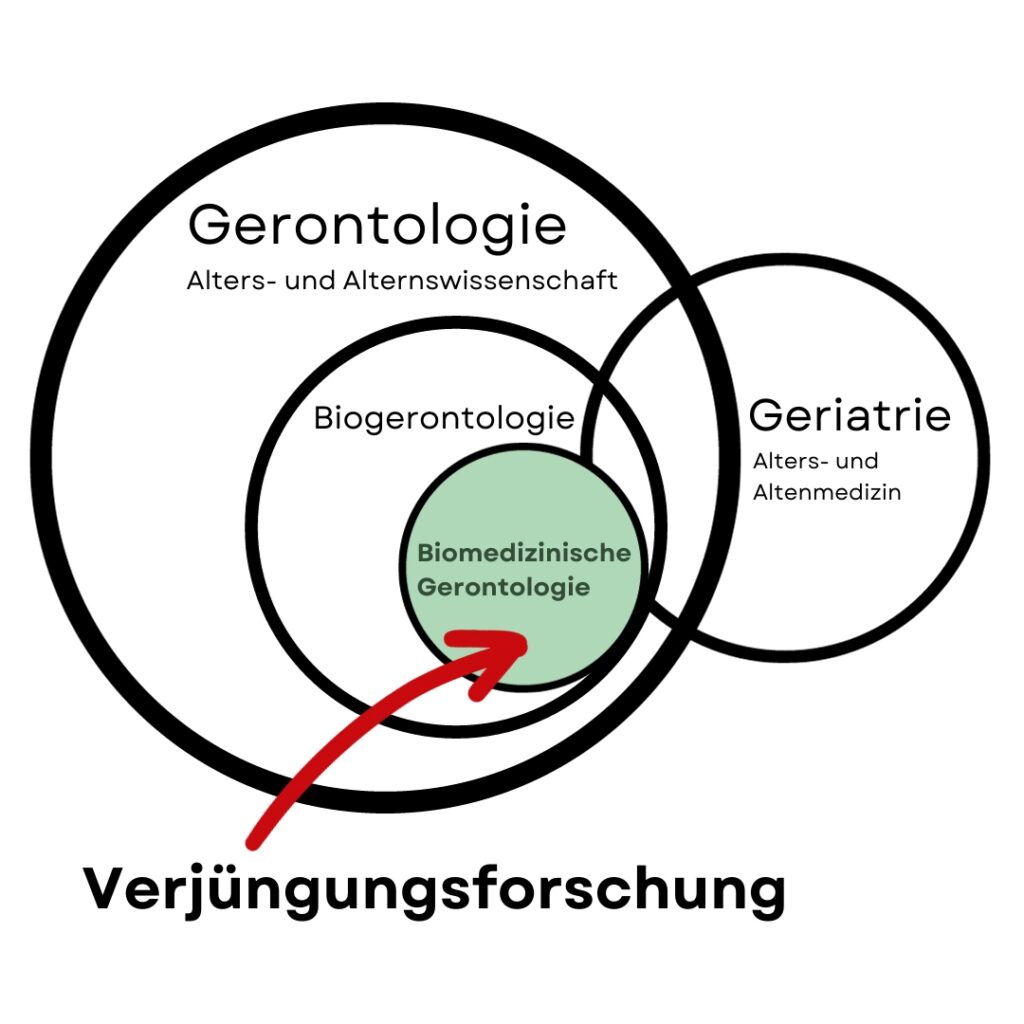
The term "rejuvenation research" is - like the term biomedical gerontology - goal-oriented: the goal is rejuvenation.
Rejuvenation research can therefore be regarded as a subtype of biomedical gerontology, since rejuvenation research is less about preventing aging or "only" slowing it down: the focus is on researching ways in which aging processes that have already taken place can be reversed.