In Germany, 1.5 billion is invested every year in research in the field of human medicine and health sciences.1 A large part of this money goes into research on specific diseases, such as Alzheimer's dementia or cancer.
But is research on specific age-related diseases really the best use of this money? How much does this research achieve if it is successful? How much (healthy) lifespan is gained once a treatment has been developed for one of the chronic diseases?
Chronic diseases in old age
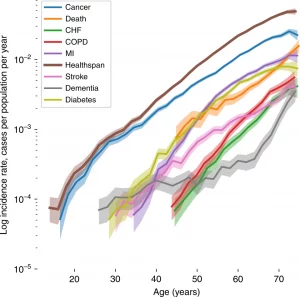
Incidence of the most common chronic diseases as a function of age2
The statistics shown here, from a study that can be read in Nature, show that the incidence of the chronic diseases shown rises exponentially from the age of twenty. What at first looks like a linear graph is in fact an exponential one if you take a closer look at the labeling of the y-axis. To illustrate: developing one of the chronic diseases shown at the age of 70 is a thousand times more likely than at 20.
In the study, participants who had more than one disease were counted for each disease. For example, if a participant had cancer and COPD, they were counted in the statistics once as a disease occurrence for cancer and once as a disease occurrence for COPD.
Exponential increase in the probability of disease with age
The probability of developing the chronic diseases studied increases exponentially for each of the diseases studied. This means that from a certain age onward, it is very likely that you will develop them. And that just one year later it is much more likely than one year earlier. And so on.
What this also means: if, from a certain age onward, you develop one of the chronic diseases, for example cancer, and actually manage to get rid of the cancer through successful cancer treatment, the next chronic disease, for example diabetes, will very likely be waiting for you shortly afterwards. As just explained, this is because with increasing age the probability of developing the chronic diseases mentioned is immensely high.
This means that lifespan will not increase much through the treatment of a single chronic disease.
That is why the current solutions, which focus exclusively on curing individual diseases, are both expensive and very inefficient if we want to make progress in our endeavor to live longer in good health. We need medicine that removes all the hurdles [Note: "hurdles" in the sense of age-related diseases/chronic diseases].
David Sinclair, "Das Ende des Alterns", p. 122
The end of healthspan
One of the lines (Healthspan) does not represent a disease, but the age at which the first disease begins - that is, the point at which healthspan ends. The starting point of a person's chronic illness. Interestingly, for most people healthspan ends with cancer, a myocardial infarction or diabetes, and only in very rare cases with death. This means that most people have a phase in their lives in which they are chronically ill before they die.
| Clinical data | Interview data | Combined data | ||||
|---|---|---|---|---|---|---|
| Events | % | Events | % | Events | % | |
| Cancer | 66,214 | 51.4 | 41,485 | 48.6 | 74,172 | 51.3 |
| Diabetes | 20,019 | 15.5 | 23,134 | 27.1 | 26,026 | 18.0 |
| MI | 25,649 | 19.9 | 10,150 | 11.9 | 24,751 | 17.1 |
| Stroke | 4731 | 3.7 | 6070 | 7.1 | 6902 | 4.8 |
| COPD | 6211 | 4.8 | 1484 | 1.7 | 5881 | 4.1 |
| Dementia | 769 | 0.6 | 2889 | 3.4 | 2706 | 1.9 |
| Death | 2411 | 1.9 | 0 | 0.0 | 2399 | 1.7 |
| CHF | 2850 | 2.2 | 231 | 0.3 | 1883 | 1.3 |
For the 300,447 participants in the study, the table shows which events ended their healthspan. Cancer and diabetes are the most common. Death ended the healthspan in less than 2% of all cases.2
Prolonging the period of illness
As we have just explained, developing and carrying out a treatment for one chronic disease does not bring much (healthy) lifetime. Usually the person then lives only a few years longer (in good health) than if they had not been treated. But these extra years are usually not spent in health, but in illness - one of the other diseases that have not yet been treated. As already explained above, this is because in old age the probability of developing each of the chronic diseases listed is many times higher than at a younger age. So being successful only in the treatment of a single chronic disease brings comparatively little additional quality of life.
We have reduced mortality more than we prevented morbidity.
Eileen Crimmins3
The most common chronic diseases - age as a risk factor
According to one study, 85-year-old men are diagnosed with an average of four different diseases, women with as many as five.4 They are "different ailments with different pathologies. (...) But aging is a risk factor for all of them. In fact, it is the risk factor."5
All in all, it therefore does not make sense to research exclusively the treatment of individual age-related diseases. But what would be a sensible complement?
Rejuvenation research, the repair approach and the information theory of aging
In addition to research on treatments for age-related diseases, another branch of research is probably needed: so-called rejuvenation research, which includes, among others, two fundamental approaches:
The repair approach: aging as the accumulation of damage that can be removed
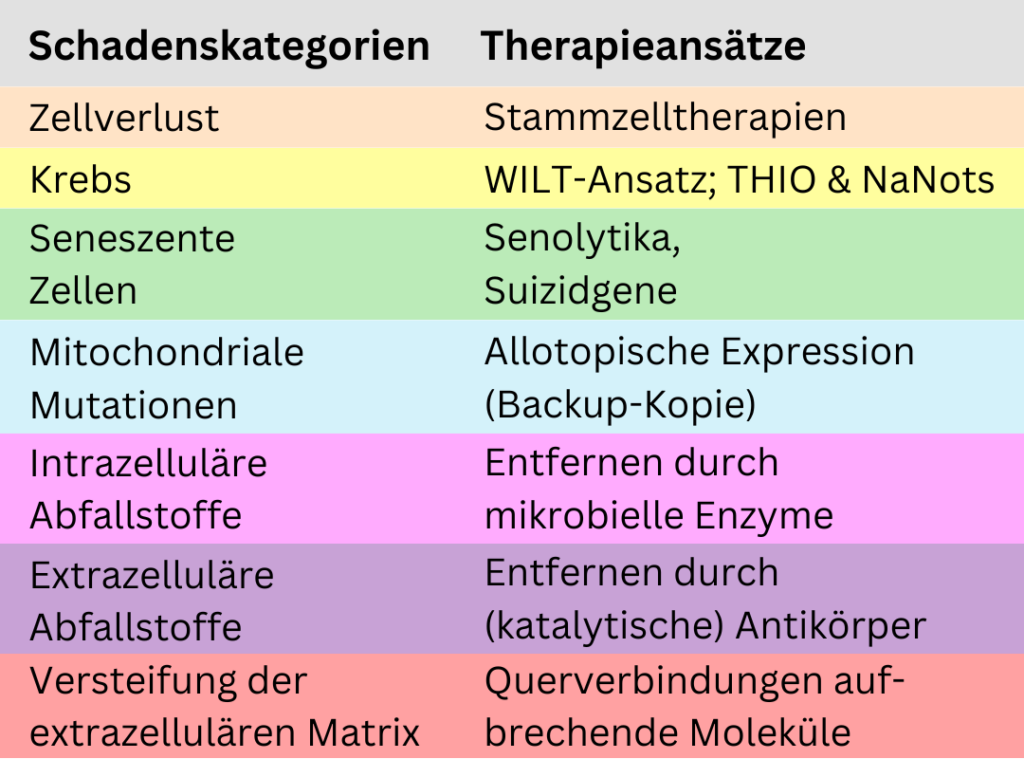
Repair approach: causes of aging according to Aubrey de Grey: damage categories and therapeutic approaches
In the repair approach, aging is interpreted as the accumulation of various types of damage that can be divided into 7 categories. The damage within one category is of a similar nature, so that it can be tackled with the same type of therapy.
The repair approach shifts the focus. While research on treatments for age-related diseases often gets bogged down in developing treatments for the symptoms or gets lost in complex metabolic pathways, the repair approach directs the focus to something else: the level of damage. So for the repair approach, you do not need to understand exactly how age-related diseases arise at the molecular level or how to combat the symptoms. You only need to understand the 7 types of damage well enough to be able to develop effective therapies against them. If you develop therapies against every category of damage - so the thesis goes - the age-related diseases we know today will not arise in the first place.
The information theory of aging: epigenetically reprogramming cells
David Sinclair's information theory of aging suggests that epigenetic changes are the cause of aging. These changes lead to a noise of information, so that the balance in the body is thrown into disarray, which leads to the symptoms of aging and the age-related diseases that we know. What exactly does that mean?
What is epigenetics?
Epigenetics deals with changes in gene activity that are not due to changes in the DNA sequence itself. These changes can cause certain genes to be switched on or off without changing the underlying DNA sequence.
It is completely normal for certain genes to be switched on and off. This also determines, for example, whether a cell is a skin cell or a muscle cell: all the cells of a person contain the same DNA sequence, but different sections of the DNA are exposed. Only the exposed sections are expressed, so that corresponding proteins are produced, which act, for example, as enzymes. In this way, each cell can produce exactly the proteins that this specific, differentiated cell needs.
Epigenetics and aging
With age, however, it changes which sections of the DNA are exposed and which are not (information noise - information that is lost). As a result, some proteins are produced that should not be produced in this cell, and some that should be produced are not, for example enzymes for DNA repair. This creates an imbalance of proteins, which probably amplifies the information noise even further - a vicious circle.
Epigenetic reprogramming, that is, returning the cell's DNA to a state in which the relevant regions are activated and the others are deactivated, could therefore prove to be the key to rejuvenation.
Does rejuvenation research make research on treatments for age-related diseases unnecessary?
No! There is a large overlap between research on age-related diseases and rejuvenation research. Both approaches can benefit from each other. However, it is important to recognize that the approach of researching age-related diseases is not sufficient. And that rejuvenation research is a promising approach whose funding does not yet do justice to its potential for health and longevity.
Sources
- Statistisches Bundesamt. (n.d.). Ausgaben, Einnahmen und Personal der öffentlichen und öffentlich geförderten Einrichtungen für Wissenschaft, Forschung und Entwicklung - Fachserie 14 Reihe 3.6 - 2020 (Letzte Ausgabe - berichtsweise eingestellt). [online] Available at: https://www.destatis.de/DE/Themen/Gesellschaft-Umwelt/Bildung-Forschung-Kultur/Forschung-Entwicklung/Publikationen/Downloads-Forschung-Entwicklung/ausgaben-einnahmen-personal-2140360207004.pdf?__blob=publicationFile [Accessed 26 Apr. 2024].
- Zenin, A., Tsepilov, Y., Sharapov, S., Getmantsev, E., Menshikov, L.I., Fedichev, P.O. and Aulchenko, Y. (2019). Identification of 12 genetic loci associated with human healthspan. Communications Biology, [online] 2(1). doi:https://doi.org/10.1038/s42003-019-0290-0.
- Crimmins, E.M. (2015). Lifespan and Healthspan: Past, Present, and Promise. The Gerontologist, [online] 55(6), pp.901-911. doi:https://doi.org/10.1093/geront/gnv130.
- Collerton, J., Davies, K., Jagger, C., Kingston, A., Bond, J., Eccles, M.P., Robinson, L.A., Martin-Ruiz, C., von Zglinicki, T., James, O.F.W. and Kirkwood, T.B.L. (2009). Health and disease in 85 year olds: baseline findings from the Newcastle 85+ cohort study. BMJ, [online] 339(dec22 1), pp.b4904-b4904. doi:https://doi.org/10.1136/bmj.b4904.
- Sinclair, D.A. and LaPlante, M.D. (2019). Das Ende des Alterns. Dumont Buchverlag, p.124.
Author: Sandra