Skip to content

News

May 14, 2017: 5,944 votes in the state election in NRW

In the state election in North Rhine-Westphalia, 5,944 voters gave us their second vote. We would like to thank them warmly for this!

With this result, around 0.1 percent, we fell short of our share of second votes of 0.5 percent in last year's election to the Berlin House of Representatives. The difference from Berlin is due to a lack of poster advertising and considerably less media presence. Our topic of age-related diseases and possible intervention strategies again met with a very interested response in conversations on the street and was considered very important, but we are simply still too little known. Nevertheless - no vote is wasted; on the contrary, every vote spurs us on to step up our efforts!

Would you like to help too? Contact us!

April 4, 2017: Party for Health Research admitted to the state election in NRW

After our hard-working helpers collected over 1,000 signatures in many cities in North Rhine-Westphalia, the State Electoral Committee admitted us to the state election on May 14, 2017. The State Electoral Committee did not admit 4 state lists, which means we are now officially among the 31 parties on the ballot.

You will find us on the ballot at position 28.

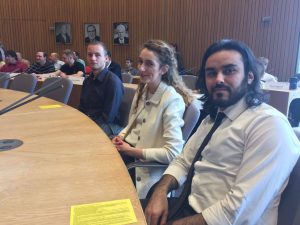
At the State Electoral Committee. From left to right: Tim Tielkes, Deputy Chair and Deputy Treasurer; Franziska Wöhle, candidate on the state list; Saif al Basri, Chair in NRW.

Which category are you in?

Which category are you in? - Aubrey de Grey on our attitude toward aging

In a passionate post on X, the well-known biogerontologist Aubrey de Grey questions our attitude toward aging and why so many people do nothing about it. He argues that we rely on irrational thought patterns and deceptive majority opinions instead of actively investing in the medical defeat of aging.

I'm overdue for a rant. Here goes.

If you don't want to get sick when you get old, but you're not allocating your time or money to hastening the medical defeat of aging, you're in one of the following categories:

1) You think aging is a blessing in disguise

2) You're sure we will defeat aging in time for you, even though you know that plenty of experts say we won't, and you don't much care about people older than you

3) You're sure we won't defeat aging in time for you, even though you know that plenty of experts say we will, and you don't much care about people younger than you

4) You know you're behaving irrationally but you can't help yourself

Which are you? Have you been avoiding asking yourself that question?

If, on the other hand, you ARE allocating your time or money to hastening the medical defeat of aging, then you've made a decision regarding HOW to allocate it. In order to do that, you've decided whom to trust in getting the information leading to your decision. How did you identify and factor out any biases in what they told you?

Most people, including (especially?) most wealthy people, think they don't need help to factor out other people's biases. But everyone does, because some of the reasons for those biases are not at all obvious unless you're in the same business yourself. In particular, when a view is stated by the majority of experts in a field, that may be because it's correct, but it may be because they benefit from each other's approval in ways that you have overlooked.
Link to the post: https://x.com/aubreydegrey/status/1876346675444257229