
Overpopulation is one of the most common fears of people who are new to the topic of rejuvenation research. Many assume that there are already too many people on Earth today and that this situation will get dramatically worse in the future. However, the latest warning from demographers - experts in the field of population development - is not a warning about overpopulation, but about underpopulation. Furthermore, technologies are already being developed in food production, power generation and other areas that will probably greatly increase the Earth's carrying capacity in the foreseeable future.
These technologies, which we explain in more detail below, include:
- renewable energies (solar, wind, hydro, geothermal, etc.)
- nuclear fusion
- lab-grown meat (in vitro meat)
- vertical farming
- desalination plants
- aquaponics, hydroponics and aeroponics
- algae farms
- 3D printing
- genetically modified crops
- synthetic fuels
- microorganisms that eat plastic and other waste
- geoengineering
- vertical cities
- AI
According to experts, the problem of the future without rejuvenation therapies is underpopulation, not overpopulation
The growth rate of the global population has been declining steadily since the 1960s due to falling birth rates.1 According to projections, 39 countries will have a smaller population in 2050 than today.2 While the growth rate of the world population was 1.2 percent per year in 2010, growth of only 0.5 percent is projected for 2050. So if we leave rejuvenation research aside, we are approaching a plateau within this century.
That is why many experts currently fear not overpopulation in this century, but in fact underpopulation, with economic losses as a consequence.3, 4 In Europe, the population is already shrinking, even though immigration currently compensates for this to a certain extent.5
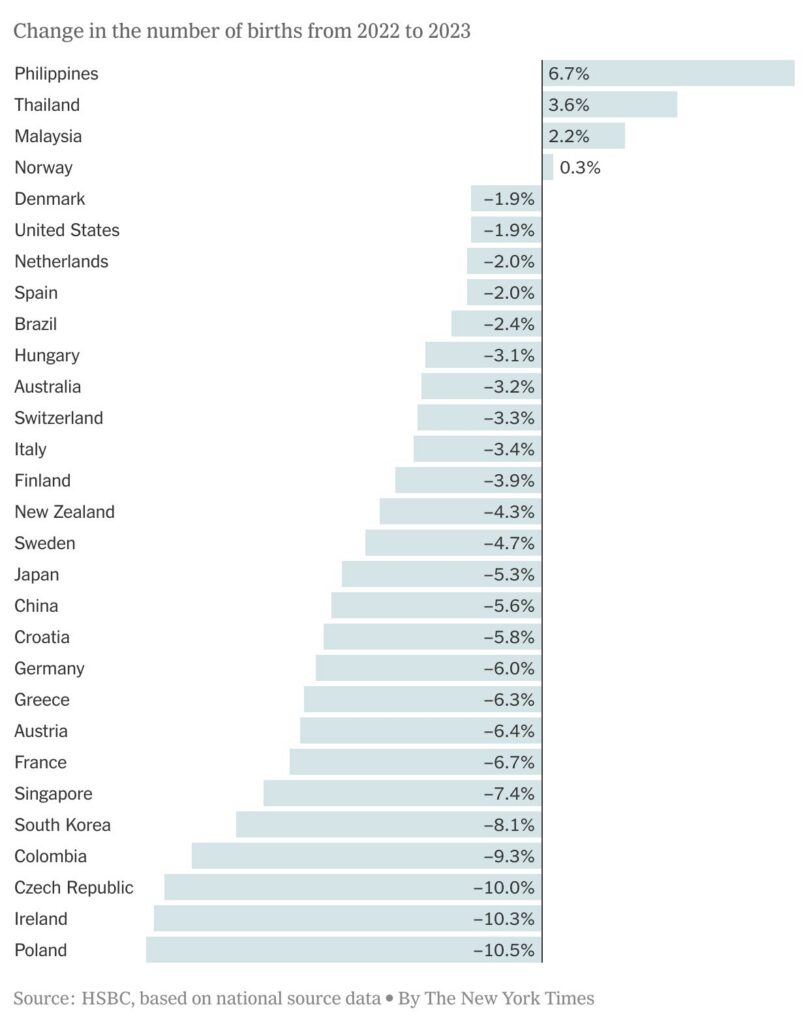
This chart from HSBC shows how sharply the number of births fell in most countries in just one year (from 2022 to 2023):
The Earth's capacity is already underestimated today
In terms of space for the people themselves alone (regardless of supplying them, for example with food), the Earth could cope with very, very many more people, as Tim Urban, among others, makes clear in his well-known blog "Wait But Why".6
In addition, calculations show that in a scenario without age-related death, the population grows much more slowly than one would intuitively assume.7 The reason is that the birth rate is much more important for population growth than the death rate: having children means (generally speaking) that a growing number of children are born, because many children in turn have children of their own after 20 or 30 years. Fewer deaths, on the other hand, are a constant rate.
It would take an extreme increase in population, lasting many centuries, to create a space problem on Earth. And it makes little sense to decide not to develop life-saving medicine on the basis of what might be the case in a few hundred years - and to assume that we will not find any other solutions to the problem by then.
Some experts, such as Erle C. Ellis, professor of geography and environmental systems at the University of Maryland, even go so far as to say that there is no "natural" upper limit: "The idea that humans must live within the natural environmental limits of our planet denies the realities of our entire history, and most likely the future. Humans are niche creators. We transform ecosystems to sustain ourselves. This is what we do and have always done. Our planet's human-carrying capacity emerges from the capabilities of our social systems and our technologies more than from any environmental limits."8
In addition, pessimistic scenarios often underestimate human adaptability. Humans are not passive beings that multiply blindly until resources are exhausted. Worldwide we see a prosperity dip: the higher life expectancy and the standard of living, the fewer children people have. In a world in which resources became scarce, the birth rate would most likely fall on its own due to crowding effects (social pressure, lack of space, costs).
Population development with rejuvenation therapies
What would a scenario look like in which, thanks to rejuvenation therapies, no one would have to die an age-related death anymore? Harvard professor David Sinclair writes in his book "Das Ende des Alterns":
"If we were to stop all deaths - every single one around the globe - right now, we would add about 150,000 people to our planet each day. That would be 55 million people each year. That might sound like a lot, but it would be less than a single percentage point. At that rate, we would add a billion people to our ranks every eighteen years, which is still considerably slower than the rate at which the last few billion people have come along and easily countered by the global decline in family sizes." (Sinclair, 2019, p. 328)
According to him, this would still be an increase, but not the kind of exponential growth that many people worry about when they first hear about the idea.
A more precise calculation shows that even with an unlimited life expectancy, we reach a plateau beyond which the population no longer grows if the global average birth rate falls below two children per family (it is currently around 2.4). The reason is that each following generation is always smaller than the one before it. This can be determined with the following formula:
Σ(I = 0; t) N0 * (c * 0.5)i
t denotes the number of generations examined, N0 is the starting population and c is the average number of children for the female part of the population (roughly half are female, hence 0.5). i is increased by one with each addition, up to t.
The principle explained here is not necessarily obvious at first glance. It therefore helps to illustrate it with a simple diagram:
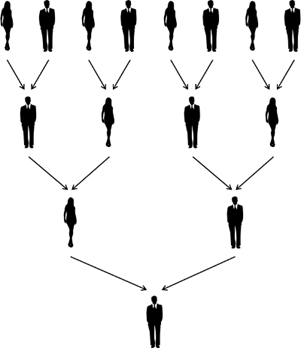
We start with a population of eight. If each couple has exactly one child, four people are added in the second generation. In the third, we add two, and finally one more child. In the end, we arrive at a total population of 8+4+2+1 = 15 people. Everyone except the last person has now had a child, and if each couple has only one child, the population stops growing at this point. (This principle still applies even if the average number of children per woman is between one and two.)
Even with rejuvenation medicine, people will still die, for example in accidents. Aging is the most common cause of death, but not the only one. Population growth in the model presented is therefore stronger than in reality.
Since rejuvenation therapies are also expected to be able to postpone menopause indefinitely,9 women would also have the chance to have children much later, for example in order to devote themselves to their careers first. The later people have children, the more slowly the population grows, even if they have more than two children in total.
Overpopulation through more children?
Some argue that people with a much longer lifespan will also have significantly more children, because they will want to have that experience again and again. However, since over time they could also look after their grandchildren, great-grandchildren, great-great-grandchildren and so on and watch them grow up, this is rather unlikely. The current average birth rate in Germany, for example, is 1.5. This means that on average you would have 2.25 grandchildren, 3.375 great-grandchildren, 5.0625 great-great-grandchildren and so on. In addition, more and more people are already consciously deciding not to have children.
So the question regarding overpopulation is not how long people live. Rather, it is whether we will continue to manage to develop the technologies that allow us to stay one step ahead of population growth. But first, the advantages of a growing population.
Advantages of a growing population
In fact, it can be argued that, among other things, the increase in the world population over the last 200 years is what has made possible the high standard of living that many people enjoy today. For example, it has ensured that a welfare recipient in Germany today is better off than a king in the 17th century: even poorer people usually have a cell phone, access to the internet and to medicine (which did not exist in the past), a significantly higher life expectancy, and generally benefit from a much greater body of human knowledge. As recently as the beginning of the 20th century, only one in five people worldwide could read; today it is four in five. Child mortality has fallen from more than 36% in 1900 to below 8%.
Why does population growth contribute to this development? Because of the benefits that arise from the networked human capital of all age groups. The term "human capital" refers to both the knowledge and the skills of the individual person. An increase in population therefore leads to an increase in social network relationships that drive progress. Or, as José Cordeiro and David Wood write in their book "Der Sieg über den Tod":
"More people thinking, more people working, more people creating, more people innovating, more people discovering, more people inventing."
Life expectancy is also an indispensable part of the Human Development Index (HDI). It correlates with the other components such as education and general quality of life. A higher life expectancy, which can go hand in hand with population growth, reinforces these components synergistically, as a number of studies have shown.10, 11, 12, 13
Resources and pollution: current situation and new technologies
In order to sustainably enable a high quality of life for a growing world population, we need to manage to use our resources (above all food, water and energy) more efficiently and to reduce pollution (greenhouse gases, particulate matter, heavy metals, plastic, etc.).
That is why we will briefly look at the current situation regarding the most important resources and then present possible technologies for increasing the Earth's capacity.
Current situation
Food
As early as 1963, the Agricultural Economics Research Institute in Oxford calculated that agricultural productivity even then would have been sufficient to feed 45 billion people (about 550 people per square kilometer). This estimate assumes that the minimum food requirement is about 500 kilograms of dry matter per person per year and that more than half of the world's land area (around 82 million square kilometers) is available for agriculture.14 However, it must be taken into account that people need to consume not only enough calories, but also enough of all essential nutrients.
Since this calculation, our agricultural capabilities have improved considerably thanks to the "Green Revolution" (advances such as fertilizers and efficient irrigation). Why, then, do so many people still suffer from hunger? This is often not because the technologies needed to prevent hunger are lacking, but because they are not used - or because of poor economic policy.15 An increase in life expectancy, however, is not a reason for it. Large-scale studies such as the Global Burden of Disease Study (GBD), which involves several hundred scientists from around 50 countries, also show that overnutrition is now a bigger global health problem than undernutrition.16 In other words: more people die from too much food than from too little. This would not be possible if our society had insufficient food production, because then the food for the overnutrition of so many people would not even exist, and problems such as obesity could not play such a large role.
On top of that, we waste enormous amounts of food. Global society literally throws away half of all edible food every year.17 This does not even take into account other deplorable practices such as the fact that the grain the USA uses to produce ethanol fuel alone could feed around 500 million people, even though ethanol shows no significant advantages over conventional petroleum fuels in terms of CO2 balance and climate protection.18
The world population has doubled since 1970, but the probability of someone dying of hunger is more than ten times lower than it was then - and twenty times lower than back when the world population was four times smaller than today.19
Much less clear is how the prevalence of, for example, micronutrient deficiencies has changed. A 30-year-old study estimates that around two billion people are affected by micronutrient deficiencies. A more recent study assumes that even more people are affected. However, the two studies cannot easily be compared, so it is not possible to say whether the deficiencies have increased or decreased.20
The need for more food production represents an excellent opportunity for entrepreneurs, which is why it is unlikely that technological progress in this area will suddenly come to a standstill, especially considering the need for rapid change due to current environmental problems.
Water
Considerable progress has been made in access to drinking water. During the period of the Millennium Development Goals (1990-2015), the use of clean drinking water worldwide is estimated to have risen from 76 percent to 91 percent. Since 1990, 2.6 billion people have gained access to a clean drinking water source. The MDG target of 88 percent was exceeded in 2010, and in 2015, 6.6 billion people used a clean drinking water source. Today there are only three countries (all in sub-Saharan Africa and Oceania) with a coverage rate of less than 50 percent, compared with 23 in 1990.21 Nevertheless, many people around the world still do not have safe access to clean drinking water.
Basically, water remains in the atmosphere and is constantly recycled through rain. So we cannot simply "run out" of it.22
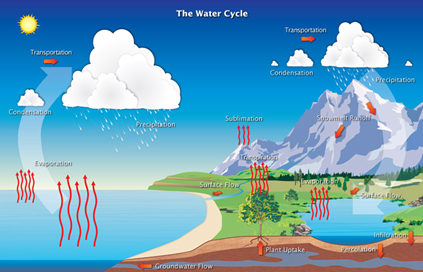
We cannot run out of water: it evaporates from the sea - in a warmer world, there is more rain. Image source: NASA Earth Observatory. https://earthobservatory.nasa.gov/features/Water/page2.php
There are two ways to ensure that the population is supplied with water:
- saving as much water as possible (for example through the effective collection and treatment of wastewater and by avoiding water losses due to damaged pipes or irrational water consumption)
- implementing new options for freshwater production (desalination plants, extracting water from the air, etc.)
Here is an interesting source on how India can solve its water problem: https://debunkingdoomsday.quora.com/How-can-Indians-prevent-future-water-shortages-Big-report-for-23-cities
Energy
The English think tank Carbon Tracker predicts a peak in demand for all fossil fuels in the 2020s if the current trend continues.23
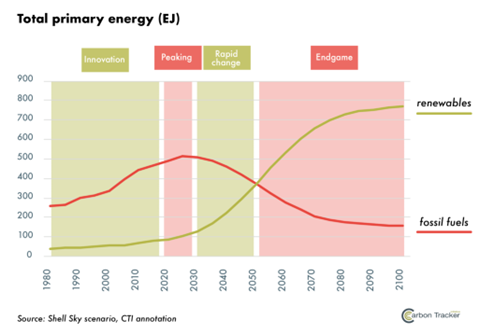
Worries that we will soon run out of oil or gas are now outdated, because there is enough of both. At current production levels, conventional oil and gas will last for a little more than half a century,24, 25 but there is enough coal for around 130 years26 and enough shale oil for 34 years.27 So the reserves will last much longer than we will need them.
The real question is when we will reach peak demand as a result of the energy transition. For coal, we already reached peak demand in 2014.
There are deep oil deposits whose extraction is becoming more and more expensive, while at the same time the costs of renewable energies are falling much faster than expected.28 That is why we are currently seeing a rapid transition from fossil fuels (especially coal, the fuel with the greatest negative impact on the environment and human health) to renewable energy sources.29, 30
New technologies
Renewable energies
Renewable energies include solar energy, hydropower, wind power, geothermal energy and ocean energy, among others. They are already being discussed everywhere and are already used in many ways today. Almost all experts agree that we need to expand them further in order to cope with the climate crisis. However, a lot of research is still needed to improve the efficiency of renewable energy technologies and to develop more environmentally friendly energy storage options.
Lab-grown meat
According to many experts, in vitro meat, also known as lab-grown meat, has the potential to solve major global problems related to the environmental impact of meat production, animal welfare and health.31, 32, 33 It is produced by means of tissue engineering. For this, muscle tissue is taken from an animal and stem cells are extracted from it. These are multiplied in a container with the help of a nutrient solution. On scaffolds, the cells grow together into a larger mass. Experiments are also being carried out with 3D printers. In Singapore, there are already restaurants that serve lab-grown meat. One of the many advantages is that, under the right conditions, antibiotics can be dispensed with. The meat can be designed to contain less saturated fat (which contributes significantly to the development of cardiovascular diseases) and instead fats or proteins with new properties, for example essential omega fatty acids. However, due to the high energy consumption and high costs, only relatively small amounts of meat can be produced this way so far.34
Another problem: at present, fetal calf serum is usually used for the nutrient solution. It is taken from the still-beating hearts of unborn calves, which die in the process. Alternatives based on algae, for example, are being researched intensively.35
In 2022, the lab-grown meat producer Mosa Meat developed, for the first time, a process that works without calf serum and other animal components.36
Vertical farming
Put simply, vertical farming refers to growing plants under greenhouse conditions on several levels stacked on top of each other in building complexes. Plant production thus becomes independent of the seasons, which increases productivity several times over. Since plants can be grown in this way directly in the cities where they are needed for the food supply, there is no need for refrigeration and long-distance transport, which results in less spoilage. Cultivation conserves natural resources that are threatened, for example, by deforestation, desertification and nutrient depletion. Vertical farming also makes it possible to protect wildlife populations.
The American microbiologist Dickson Despommier considers vertical farming to be feasible with current technology and has published a great deal of literature on it. According to his estimates, a 30-story farm the size of a city block could feed 10,000 people.37
Three well-known subtypes of vertical farming are hydroponics (growing plants in water without soil), aquaponics (combining hydroponics with the farming of aquatic animals) and aeroponics (growing plants with their roots constantly moistened by a mist of water and nutrients).
Quite a few countries are already trying to implement vertical farming on a smaller scale. What is still missing is a detailed analysis of economic feasibility. While transport costs are considerably lower, there are additional costs for artificial lighting, heat generation and energy supply. One of many approaches to tackling these problems is being researched at the Technische Hochschule Köln.38
Genetically modified crops
Another solution for meeting global food needs is the use of genetically modified plants that deliver higher yields, are resistant to diseases and can grow under conditions that are not favorable for organic plants. This means that genetically modified plants can also be grown where conventional plants cannot currently be grown. By using genetically modified plants, we could therefore make more of the available space usable.
There is currently a lot of discussion about using genetically modified plants to increase yields and keep pace with global demand for food. Some argue that organic plants (i.e. plants without genetic modification) are better both for the environment and nutritionally. A look at the data, however, shows that this is far from the case and merely repeats agricultural myths.39
Critics of genetically modified organisms (GMOs) often claim that organic farming uses fewer synthetic pesticides, which have been shown to be harmful to the environment.40
However, organic farms also use their own range of natural pesticides, which are still harmful.41 To make matters worse, organic farms reject technologies that could reduce or completely prevent the use of pesticides, such as genetically modifying plants to make them resistant to insects and other pests. In comparison, GMOs have the potential to increase crop yields and raise the content of essential nutrients, which can reduce the occurrence of nutrient deficiencies. Furthermore, they can improve agricultural practices while reducing the use of synthetic chemicals.
For example, sweet potatoes are being modified to be resistant to a virus that currently decimates the African harvest every year. This could feed millions of people in some of the poorest countries in the world.42
Desalination plants
Desalination of seawater is becoming cheaper and cheaper and is being used more and more widely to produce drinking water. A good example of this is a project in Israel. After the drought of 2004 to 2008, the Israeli government decided to invest in building a desalination plant. Currently, more than 50 percent of Israel's total freshwater needs are met by five desalination plants on the Mediterranean coast, which supply enough freshwater for more than four million people.43 Freshwater produced by desalination in Israel is also cheap (around 30 dollars per household per month, similar to most US households). The technology has proven so efficient that the Israeli desalination company is now building several new plants in other countries to help them solve the problem of water scarcity. In California, a new desalination plant will cover about seven percent of the drinking water needs of the San Diego region. If we built several thousand desalination plants with this capacity, the unmet freshwater needs of the world population could be covered completely. Bahrain, Japan, Saudi Arabia, China and many other countries now also use desalination plants.
One problem that still needs to be solved is the disposal of the remaining salt water, which can damage bodies of water and the organisms living in them. So far, the brine has been discharged back into the sea, and the quantities produced appear to be larger than expected.44 However, in recent years, engineers at MIT have developed a process that can convert the brine into useful chemicals such as sodium hydroxide, which in turn can be used to make the desalination process itself more efficient.45
We can also extract other valuable substances from the remaining salt; magnesium, for example, is already being extracted from seawater. Singapore has looked into extracting metals from the brine left over after desalination. For every million liters of seawater, 1,300 kg of magnesium, 900 kg of sulfur, 400 kg of calcium and 400 kg of potassium are produced, which can be recovered and have a wide range of industrial applications. Lithium is another example. It is used, among other things, to make glass, ceramics and batteries, but also as a medication.46
Synthetic fuels
Synthetic fuels are produced by a chemical process (combining hydrogen with carbon dioxide) instead of being extracted from the ground and refined.47 The carbon dioxide required can, for example, be obtained from the air (see also the section on Carbon Dioxide Removal). Ideally, the production process for synthetic fuels does not require any fossil fuels.
Synthetic fuels are particularly relevant for global shipping, which is responsible for around 3% of all man-made greenhouse gas emissions.48
One of the most promising synthetic fuels is ammonia. It releases hardly any CO2, has a high energy density and is relatively cheap compared to other emission-free fuels. However, using ammonia as a marine fuel poses safety risks, mainly due to its toxicity. Personnel on board and on shore must be specially trained and wear protective equipment, and ships must be built to a high safety standard.49 Other examples are methane, methanol and hydrogen. At the moment, it is mainly such practical problems as well as economic factors that need to be overcome before synthetic fuels can be used comprehensively in transport worldwide.
Microorganisms that eliminate waste
Various approaches are now being pursued to break down waste with microorganisms (for example bacteria or fungi). Breaking down plastic would be particularly important in order to counteract the pollution of the world's oceans. Researchers have already discovered species of fungi that can decompose some of the most common types of plastic even at room temperature.50, 51
However, this research is still at an early stage. The enzymes that enable the fungi to break the plastic down have yet to be identified. Ultimately, the idea is to use the microorganisms or their enzymes to split plastics into monomers (individual reactive molecules), which can in turn be used to produce plastic.
Algae farms
According to scientists' assessments, seaweed could make a significant contribution to fighting climate change. For example, mixing the Australian seaweed species Asparagopsis into cattle feed could reduce their methane emissions by up to 95%.52 After carbon dioxide (CO2), methane is the gas that contributes second most to global warming.
Researchers from Australia and Austria propose replacing ten percent of the human diet with algae. Since growing algae requires less land, this reduces greenhouse gas emissions in agriculture. Unfortunately, many people are still averse to eating algae, although, as with other new trends, this may well change soon.53, 54
3D printing
With 3D printing, the situation is similar to that of seaweed: while there is considerable progress, the obstacle is many people's attitude toward the possibility. The technology also still needs to be researched further and improved in order to provide food on a mass scale. According to experts, however, 3D printing has great potential to reduce world hunger and secure the global supply of nutrients. A big advantage is that it allows food to be specifically designed to cover all important nutrients in sufficient quantities and to taste as good as possible.55
Carbon Dioxide Removal
Carbon Dioxide Removal (CDR), also called "negative CO2 emissions", is a form of geoengineering. As the name suggests, it is intended to remove CO2 from the atmosphere in order to counteract the greenhouse effect and global warming. However, there are concerns about costs, land use and general feasibility. Some climate researchers point out that policymakers must not count on negative emissions in the future to justify the current lack of measures to reduce emissions.56
Solar Radiation Management
Another much-discussed form of geoengineering is Solar Radiation Management. Unlike CDR, it does not target CO2, but sunlight, which is to be shielded or reflected back into space to a greater extent. This can be done, for example, by brightening or creating clouds and by introducing aerosols (such as sulfur dioxide) into the stratosphere. Research is also already being done on gigantic shields in space that are intended to block incoming sunlight.57 Experts suspect that such measures could bring about a cooling effect fairly quickly. Here too, however, it is unclear whether the costs are really bearable and whether SRM projects can be implemented in time as a measure against climate change. In addition, SRM does not change the root cause of global warming: the high concentration of greenhouse gases in the Earth's atmosphere. It therefore cannot counteract ocean acidification.
Nuclear fusion
Nuclear fusion could bring about a radical change in power generation. In this process, two atomic nuclei fuse into a new nucleus, releasing a considerable amount of energy. This would make it a practically inexhaustible source of energy without the risk of catastrophic accidents and without producing nuclear waste.58 However, it is difficult to predict when we will have this option for generating electricity. The most promising research project is ITER (short for International Thermonuclear Experimental Reactor) in southern France, an experimental reactor in which the fusion process is to be demonstrated. It is scheduled to start operating in 2028. The first reactors are likely to be ready for use about 20 years later.59 Many other types of nuclear fusion are also being researched, including laser fusion. One interesting concept, for example, is the Polywell.60
Artificial intelligence
Given the rapid progress of AI, it is hard to predict how this field will change our world. A superintelligence (i.e. an AI that is far more intelligent than humanity) could probably find solutions quickly even for complex problems such as climate change. But AI is already helping with climate protection measures today: for example, it tracks wildlife populations, monitors icebergs and even predicts natural disasters such as forest fires and floods.61
Vertical cities
Vertical urbanization, i.e. human living space in the form of a very tall building or a network of interconnected tall buildings, could enable a large number of people to live together in a resource-efficient way. In India, such a project is already being implemented.62 Architects around the world are working on models for many more vertical cities. Parks, shopping areas, cafés and so on are to be inserted at regular intervals between the living space, for example with the help of autonomous flying robots.63
Space colonies/terraforming
Terraforming refers to the settlement of other planets by humanity. In the more distant future, a growing population could thus avoid a possible space problem. Undoubtedly an exciting topic - but at present we are still very far from putting this into practice.
Biodiversity
Besides the climate crisis, there is also talk of the biodiversity crisis, or species extinction. While this is undoubtedly an important challenge of our time, the frequently cited figure of 150 animal and plant species going extinct every day is probably an overestimate.64
Parts of the reasoning in the section on resources also apply to the topic of biodiversity. Regardless of this, however, we are already doing a lot to stop and reverse the loss of biodiversity. A good example is the reforestation of Easter Island.65 We can also do a lot to protect insect populations. In principle, it is to be expected that there will be more insects in a warmer world. The challenge is the combination of a warmer world and intensive agriculture.66
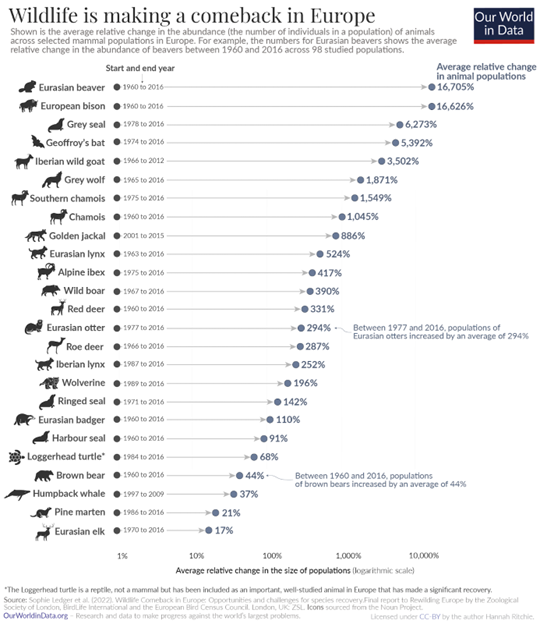
We are not heading toward a world without swallows or brown bears. In fact, the number of mammals in Europe is currently increasing across the board. This shows that nature conservation works.67
COP15 (the 15th UN Biodiversity Conference) also went very well. Over 90 countries agreed to manage 30% of their land, sea and inland water areas for the conservation of biodiversity by 2030. In addition, subsidies that harm nature are to be stopped and redirected.68
A longer and therefore more relaxed life through rejuvenation therapies will probably lead us to value our own lives and the lives of other living beings more than we do today, when we live only briefly and "fast" - and therefore do not have as much of our own lifetime or future to lose. Air pollution, the clearing of the rainforest and other environmental problems could decrease thanks to rejuvenation therapies.
The main argument, however, is this: in five billion years at the latest, the sun will burn up all life on Earth. Humankind is therefore a source of hope rather than doom, because it is the only living being that has the potential to save all species and, for example, relocate them to other planets.
Possible solutions in the event of overpopulation
In the unlikely event that resources become scarce, the birth rate would need to be adjusted. But the dilemma is clear: is it worse to temporarily forgo having children, or to knowingly send over 100,000 people a day to an often agonizing death? For us, the answer is clear: we must not sacrifice existing people just to make room for new ones.
Contraceptives and support for women
Measures to reduce the birth rate do not have to include a ban. Strengthening women's rights and improving educational opportunities can already achieve a lot. South Korea is the best example of this: there, the average birth rate is now only 0.7. If the birth and death rates there stay the same, the South Korean population will be only half its current size by the end of the century.69
Promoting the development of contraceptives for men could (together with condoms and contraception for women) reduce the number of unwanted children. 40% of all pregnancies are unintended.70 We could relieve women of the financial burden of abortions and offer the associated psychological support free of charge.
Income tax based on the number of children
Another option is to increase income tax step by step with the number of children. This could be graduated so that people with higher incomes also have to pay more in addition. Another idea is the introduction of an unconditional basic income for everyone who is, for example, older than 25. This would make additional children more expensive than today.
In an absolute emergency, a temporary suspension of the wish for children would have to be considered, e.g. through contractual agreements: anyone who uses rejuvenation therapies commits to forgoing further children for a certain period of time. It may then also be possible to freeze egg cells and sperm and let the embryos mature at a later point in time in an artificial system outside the mother's body (ectogenesis). However, legislators would have to develop strict mechanisms to prevent abuse and the emergence of an unregulated black market.
At this point, many people argue that it is selfish and unfair to extend our lives and in return have fewer children, because we thereby deny unborn people the chance to come into the world at all. But we follow a long and reasonable ethical tradition of attaching more value to born people than to unborn people. If we considered people who have not even been conceived yet to be just as important as people who are already alive, the only ethically justifiable thing would be to have as many children as possible - and to do so all the time. From this perspective, using condoms or contraception in general would therefore be inexcusable.
It is ethically unjustifiable to let an existing person - who loves, thinks, feels and wants to live - die just to make room for someone who does not even exist yet. Dying of aging is worse than not being conceived, because people to whom the latter applies cannot suffer, since they have no nervous system and therefore no consciousness or ability to feel pain. According to consequentialist ethics, it is therefore necessary to give preference to born life over unborn life.
Conclusion
In summary: overpopulation will most likely not occur, and if it does, there are much better ways to solve the problem than letting people die of age-related diseases or old age.
Another good article on the topic of overpopulation:
Sources
- Population Reference Bureau (2021). 2021 World Population Data Sheet. https://www.prb.org/resource/2021-world-population-data-sheet/
- SDG Knowledge Hub (2021). 2021 Population Data Sheet Highlights Declining Fertility Rates. International Institute for Sustainable Development: Winnipeg, Canada. https://sdg.iisd.org/news/2021-population-data-sheet-highlights-declining-fertility-rates/
- https://www.tagesschau.de/ausland/weltbevoelkerung-133.html
- Vollset SE, Goren E, Yuan CW, Cao J, Smith AE, Hsiao T, Bisignano C, Azhar GS, Castro E, Chalek J, Dolgert AJ, Frank T, Fukutaki K, Hay SI, Lozano R, Mokdad AH, Nandakumar V, Pierce M, Pletcher M, Robalik T, Steuben KM, Wunrow HY, Zlavog BS, Murray CJL. Fertility, mortality, migration, and population scenarios for 195 countries and territories from 2017 to 2100: a forecasting analysis for the Global Burden of Disease Study. Lancet. 2020 Oct 17; 396(10258): 1285-1306. doi: 10.1016/S0140-6736(20)30677-2. https://www.thelancet.com/article/S0140-6736(20)30677-2/fulltext
- https://www.euronews.com/next/2023/04/04/china-sees-first-population-decline-in-six-decades-where-does-the-eu-stand
- https://waitbutwhy.com/2015/03/7-3-billion-people-one-building.html
- Gavrilov LA, Gavrilova NS. Demographic consequences of defeating aging. Rejuvenation Res. 2010 Apr-Jun; 13(2-3): 329-34. doi: 10.1089/rej.2009.0977. https://www.ncbi.nlm.nih.gov/pmc/articles/PMC3192186/
- https://www.nytimes.com/2013/09/14/opinion/overpopulation-is-not-the-problem.html
- https://lifespan.io/michael-rae/rejuvenation-biotechnology-toward-indefinite-postponement-menopause/
- Russ TC, Stamatakis E, Hamer M, Starr JM, Kivimäki M, Batty GD. Association between psychological distress and mortality: individual participant pooled analysis of 10 prospective cohort studies. Br Med J 2012; 345: e4933. doi: 10.1136/bmj.e4933. https://www.bmj.com/content/345/bmj.e4933.long
- Rizzuto D, Orsini N, Qiu C, Wang H-X, Fratiglioni, L. Lifestyle, social factors, and survival after age 75: population based study. Br Med J 2012; 345: e5568. doi: 10.1136/bmj.e5568. https://www.bmj.com/content/345/bmj.e5568.long
- Rogot E, Sorlie PD, Johnson NJ. Life expectancy by employment status, income, and education in the National Longitudinal Mortality Study. Public Health Rep 1992; 107(4): 457-461. https://www.ncbi.nlm.nih.gov/pmc/articles/PMC1403677/
- Olshansky SJ, Antonucci T, Berkman L, et al. Differences in life expectancy due to race and educational differences are widening, and many may not catch up. Health Aff 2012; 31(8): 1803-1813. doi: 10.1377/hlthaff.2011.0746. https://www.healthaffairs.org/doi/full/10.1377/hlthaff.2011.0746
- Clark C. Agricultural productivity in relation to population. Wolstenholme G, Ed. Man and his future: A CIBA foundation volume. Boston: Gordon, Little, Brown and Co. 1963; pp. 23-35.
- Peter Walker, Famine Early Warning Systems: Victims and Destitution. Earthscan Publications Ltd. London, 1989.
- Murray CJ, Ezzati M, Flaxman AD, Lim S, Lozano R, Michaud C, Naghavi M, Salomon JA, Shibuya K, Vos T, Lopez AD. GBD 2010: a multi-investigator collaboration for global comparative descriptive epidemiology. Lancet. 2012 Dec 15; 380(9859): 2055-8. doi: 10.1016/S0140-6736(12)62134-5. https://www.thelancet.com/journals/lancet/article/PIIS0140-6736(12)62134-5/abstract
- https://www.theguardian.com/environment/2013/jan/10/half-world-food-waste
- https://www.washingtontimes.com/news/2015/jun/2/h-sterling-burnett-an-immoral-food-to-fuel-policy/
- https://ourworldindata.org/famines#long-term-trends-in-global-famine-mortality
- Stevens GA, Beal T, Mbuya MNN, Luo H, Neufeld LM; Global Micronutrient Deficiencies Research Group. Micronutrient deficiencies among preschool-aged children and women of reproductive age worldwide: a pooled analysis of individual-level data from population-representative surveys. Lancet Glob Health. 2022 Nov; 10(11): e1590-e1599. doi: 10.1016/S2214-109X(22)00367-9. https://www.thelancet.com/journals/langlo/article/PIIS2214-109X(22)00367-9/fulltext
- UNICEF (2015). Progress on Sanitation and Drinking Water: 2015 Update and MDG Assessment. World Health Organization (WHO): Geneva, Switzerland.
- https://debunkingdoomsday.quora.com/No-we-won-t-have-large-scale-water-wars-price-of-water-is-too-low-below-price-of-desalination-for-long-distance-trans
- Bond K (2018). 2020 vision: why you should see the fossil fuel peak coming. Carbon Tracker Initiative: London, England.
- BP p.l.c. (2021). BP Statistical Review of World Energy 2021. London, England.
- https://www.worldometers.info/oil/#oil-reserves
- https://www.futurecoal.org/coal-facts/what-is-coal-where-is-it-found/
- Knaus E, Killen J, Biglarbigi K, Crawford P. An Overview of Oil Shale Resources. In: Olayinka Ogunsola, Arthur Hartstein and Olubunmi Ogunsola (eds.): Oil Shale: A Solution to the Liquid Fuel Dilemma. ACS Symposium Series, American Chemical Society: Washington, D.C. 2010, ISBN 978-0-8412-2539-8.
- https://ourworldindata.org/cheap-renewables-growth
- https://ec.europa.eu/eurostat/statistics-explained/index.php?title=Renewable_energy_statistics / https://ec.europa.eu/eurostat/web/products-eurostat-news/-/ddn-20220201-1/
- https://ec.europa.eu/eurostat/web/products-eurostat-news/-/edn-20220211-1
- Bryant CJ. Culture, meat, and cultured meat. J Anim Sci. 2020 Aug 1; 98(8): skaa172. doi: 10.1093/jas/skaa172. https://academic.oup.com/jas/article/98/8/skaa172/5880017
- Hong TK, Shin DM, Choi J, Do JT, Han SG. Current Issues and Technical Advances in Cultured Meat Production: A Review. Food Sci Anim Resour. 2021 May; 41(3): 355-372. doi: 10.5851/kosfa.2021.e14. https://pmc.ncbi.nlm.nih.gov/articles/PMC8112310/
- Treich N. Cultured Meat: Promises and Challenges. Environ Resour Econ (Dordr). 2021; 79(1): 33-61. doi: 10.1007/s10640-021-00551-3. https://link.springer.com/article/10.1007/s10640-021-00551-3
- https://www.geo.de/wissen/forschung-und-technik/laborfleisch--wie-es-gezuechtet-wird-und-was-es-kostet-34250506.html
- https://www.verbraucherzentrale.de/wissen/lebensmittel/lebensmittelproduktion/clean-meat-ist-laborfleisch-die-zukunft-65071
- 2014 Messmer T, Klevernic I, Furquim C, Ovchinnikova E, Dogan A, Cruz H, Post MJ, Flack JE. A serum-free media formulation for cultured meat production supports bovine satellite cell differentiation in the absence of serum starvation. Nat Food. 2022 Jan; 3(1): 74-85. doi: 10.1038/s43016-021-00419-1. https://www.nature.com/articles/s43016-021-00419-1
- Despommier D. Reducing the impact of agriculture on ecosystem functions and services. Vertical Farm, 2008. https://web.archive.org/web/20090701091951/http://www.verticalfarm.com/essay_print.htm
- https://www.th-koeln.de/hochschule/ki-beleuchtungssystem-fuer-effizientes-vertical-indoor-farming_109999.php
- Hielscher S, Pies I, Valentinov V, Chatalova L. (2016). Rationalizing the GMO Debate: The Ordonomic Approach to Addressing Agricultural Myths. International Journal of Environmental Research and Public Health, 13(5), 476. doi: 10.3390/ijerph13050476. https://www.mdpi.com/1660-4601/13/5/476
- Aktar, W., Sengupta, D., & Chowdhury, A. (2009). Impact of pesticides use in agriculture: their benefits and hazards. Interdisciplinary toxicology, 2(1), 1-12. doi: 10.2478/v10102-009-0001-7. https://www.ncbi.nlm.nih.gov/pmc/articles/PMC2984095/
- Bahlai, C. A., Xue, Y., McCreary, C. M., Schaafsma, A. W., & Hallett, R. H. (2010). Choosing organic pesticides over synthetic pesticides may not effectively mitigate environmental risk in soybeans. PLoS One, 5(6), e11250. doi: 10.1371/journal.pone.0011250. https://journals.plos.org/plosone/article?id=10.1371/journal.pone.0011250
- Qaim, M. (1999). The economic effects of genetically modified orphan commodities: projections for sweetpotato in Kenya. ISAAA.
- https://www.scientificamerican.com/article/israel-proves-the-desalination-era-is-here/
- https://www.nationalgeographic.de/umwelt/2019/01/entsalzungsanlagen-produzieren-mehr-giftige-sole-als-erwartet
- https://news.mit.edu/2019/brine-desalianation-waste-sodium-hydroxide-0213
- https://www.miningweekly.com/article/over-40-minerals-and-metals-contained-in-seawater-their-extraction-likely-to-increase-in-the-future-2016-04-01/
- https://www.euractiv.com/section/global-europe/opinion/bolstering-baltic-security-through-energy-innovation/
- https://www.handelsblatt.com/unternehmen/industrie/klimastatistik-schwimmende-klimasuender-co2-emissionen-der-schifffahrt-wachsen/25318528.html
- https://www.wri.org/insights/how-to-decarbonize-international-shipping
- https://www.tagesschau.de/wissen/forschung/bakterien-plastik-arktis-100.html
- Rüthi J, Cerri M, Brunner I, Stierli B, Sander M, and Frey B (2023). Discovery of plastic-degrading microbial strains isolated from the alpine and Arctic terrestrial plastisphere. Front Microbiol. 14: 1178474. doi: 10.3389/fmicb.2023.1178474 https://www.frontiersin.org/journals/microbiology/articles/10.3389/fmicb.2023.1178474/full
- Roque BM, Salwen JK, Kinley R, Kebreab E. Inclusion of Asparagopsis armata in lactating dairy cows' diet reduces enteric methane emission by over 50 percent. J Clean Prod. (2019) 234: 132-8. 10.1016/j.jclepro.2019.06.193. https://www.sciencedirect.com/science/article/abs/pii/S0959652619321559
- Spillias, S., Valin, H., Batka, M. et al. Reducing global land-use pressures with seaweed farming. Nat Sustain 6, 380-390 (2023). doi: 10.1038/s41893-022-01043-y. https://www.nature.com/articles/s41893-022-01043-y
- https://www.rnd.de/wissen/algen-studie-zeigt-das-enorme-potenzial-im-kampf-gegen-den-klimawandel-2BXIDOEIYRDJNDUOMVUPLKRTIU.html?outputType=valid_amp
- https://www.asme.org/topics-resources/content/solving-world-hunger-3dprinted-food
- Smith P, Davis S, Creutzig F et al. Biophysical and economic limits to negative CO2 emissions. Nature Clim Change 6, 42-50 (2016). doi: 10.1038/nclimate2870. https://www.nature.com/articles/nclimate2870
- https://www.derstandard.de/story/3000000207612/koennte-ein-gewaltiger-sonnenschild-im-all-die-erde-kuehlen
- https://de.wikipedia.org/wiki/Kernfusion
- EUROFUSION & Nordlund KH (2018). European Research Roadmap to the Realisation of Fusion Energy. https://euro-fusion.org/eurofusion/roadmap/
- https://de.wikipedia.org/wiki/Polywell
- Cowls J, Tsamados A, Taddeo M, Floridi L. The AI gambit: leveraging artificial intelligence to combat climate change-opportunities, challenges, and recommendations. AI Soc. 2023; 38(1): 283-307. doi: 10.1007/s00146-021-01294-x. https://link.springer.com/article/10.1007/s00146-021-01294-x
- https://www.dbz.de/news/dbz_Vertikale_Stadt_MVRDV_Rotterdam_bauen_in_Indien_eine_ganze_Stadt_in_die-1115035.html
- https://www.wiwo.de/technologie/umwelt/vertikale-stadtplanung-eine-600-meter-hohe-stadt/9079844.html
- https://e360.yale.edu/features/global_extinction_rates_why_do_estimates_vary_so_wildly
- https://www.dw.com/en/bringing-the-trees-back-to-easter-island/a-18366801
- https://debunkingdoomsday.quora.com/New-study-insects-for-the-most-part-benefit-from-warming-in-natural-habitats-but-intensive-agriculture-is-a-challenge
- https://ourworldindata.org/europe-mammal-comeback
- https://debunkingdoomsday.quora.com/COP15-very-encouraging-outcomes-agreement-for-effective-conservation-and-management-of-30-of-land-coastal-waters-and
- https://www.dw.com/en/why-south-korean-women-arent-having-babies/a-68419317
- United Nations Population Fund (2022). Nearly half of all pregnancies are unintended - a global crisis, says new UNFPA report. https://www.unfpa.org/press/nearly-half-all-pregnancies-are-unintended-global-crisis-says-new-unfpa-report